
Executive Summary (Answer-First):
- The Problem: The Srama Group suffered from an extended 62-day property sales cycle and high data latency caused by brokers manually relaying field voice notes to coordinators to retype into CRM and spreadsheets.
- The Solution: System AI architected a 4-layer automation pipeline using self-hosted n8n: ingesting WhatsApp audio/text via Twilio, transcribing with Whisper, parsing entities with LLMs, and routing data into Zoho CRM and Google Sheets.
- Key Outcomes: Slashed processing latency from 4-5 minutes to 10-20 seconds (97% reduction), compressed end-to-end sales cycles from 62 to 44 days (18 days saved), and freed 1 full workday per employee weekly.
| Operational Dimension | Manual Workflow Baseline | Automated n8n Pipeline (System AI) | Quantified Impact |
|---|---|---|---|
| Per-Task Data Entry Latency | 4 – 5 minutes / entry | 10 – 20 seconds / record | 97% latency reduction |
| Field Data Input Interface | Desktop forms / complex CRM web apps | Native WhatsApp voice notes & text | Zero behavioral friction on-site |
| Sales Cycle (Intake to Close) | 62 days | 44 days | 18 days faster (~30% acceleration) |
| Data Verification & Audit | Manual coordinator follow-ups | Direct record URL returned to chat | Instant 2-second single-tap verification |
| Automation Infrastructure Cost | Compounding SaaS execution-tier fees | Self-hosted n8n on dedicated VPS | Predictable flat-rate hosting economics |
In the real estate brokerage and asset advisory sector, speed-to-lead and speed-to-market represent the razor-thin margin between securing an exclusive transaction and losing a high-value listing to competing firms.
Yet, operational reality across brokerage teams is frequently strangled by manual administrative friction. Commercial brokers spend their working hours in the field meeting property owners, capturing notes via quick phone calls, and exchanging brief messages over mobile chat applications. Afterward, these fragmented fragments are manually forwarded to offshore virtual assistants or back-office coordinators to retype line by line into CRM tools and central spreadsheets.

Each manual entry consumes merely four to five minutes. While seemingly modest in isolation, when compounded across hundreds of active property listings and thousands of monthly inbound prospects, this administrative drag triggers severe operational penalties:
- Severe Information Latency: Fresh property mandates linger for entire days before reflecting on core dashboards, preventing sales agents from matching inventory with qualified buyers.
- Data Fragmentation and Human Transcription Errors: Virtual assistants misinterpret mobile voice memos, overlook critical zoning notes, or mistype telephone digits, making financial reconciliation an exhausting chore.
- Extended Transaction Cycles: The operational duration required to transition an asset from onboarding to final sale stretches out, locking up working capital and delaying broker commissions.
At The Srama Group, a high-velocity real estate brokerage firm operating across international markets, the average cycle time from property intake to completed transaction reached a burdensome 62 days. Consulting partner System AI stepped in to systematically dismantle this operational bottleneck using an event-driven automation architecture built on self-hosted n8n.
1. The Unit Economics Dilemma: Bypassing SaaS Execution Caps
Prior to standardizing on n8n, System AI initially prototyped integration flows across conventional cloud-based iPaaS platforms. However, the agency quickly confronted an economic penalty familiar to growing implementers: compounding execution-based subscription tiers.
As transaction throughput accelerated, monthly execution volumes surged, causing software overhead to escalate unpredictably. Engineering resources were diverted toward rationing API triggers and managing tier ceilings rather than refining operational client value.
System AI executed an infrastructure pivot to self-hosted n8n deployed on dedicated virtual private servers (VPS). This move eliminated execution caps, empowering the agency to run high-frequency, complex multi-step pipelines with zero marginal cost per run while anchoring infrastructure expenses at a predictable baseline.
2. The 4-Layer Architecture: Converting Audio Notes to CRM Records in 15 Seconds
The foundational design rule for high user adoption across commercial teams is straightforward: never force operators to abandon their native communication habits. Instead of demanding that field brokers adopt complex mobile enterprise suites or access desktop interfaces while traveling, the system selected their existing communication medium—WhatsApp—as the primary input interface.
HIGH-VELOCITY CHAT-TO-CRM PIPELINE (SYSTEM AI)

┌─────────────────────────────────────────────────────────────┐
│ 1. FIELD INGESTION (Twilio Webhook Listener)                │
│ Capture text messages and voice memos instantaneously       │
├─────────────────────────────────────────────────────────────┤
│ 2. COGNITIVE PARSING (Whisper Transcription & LLM Routing)  │
│ Transcribe audio • Extract structured entities • Route intent│
├─────────────────────────────────────────────────────────────┤
│ 3. MODULAR SUB-WORKFLOWS (n8n Execution Engine)             │
│ Leads Path ➔ Zoho CRM • Properties Path ➔ Google Sheets      │
├─────────────────────────────────────────────────────────────┤
│ 4. TRACEABLE AUDIT & FEEDBACK (Direct Record Links)         │
│ Dispatch direct row link back to chat • Log latency via LangSmith│
└─────────────────────────────────────────────────────────────┘
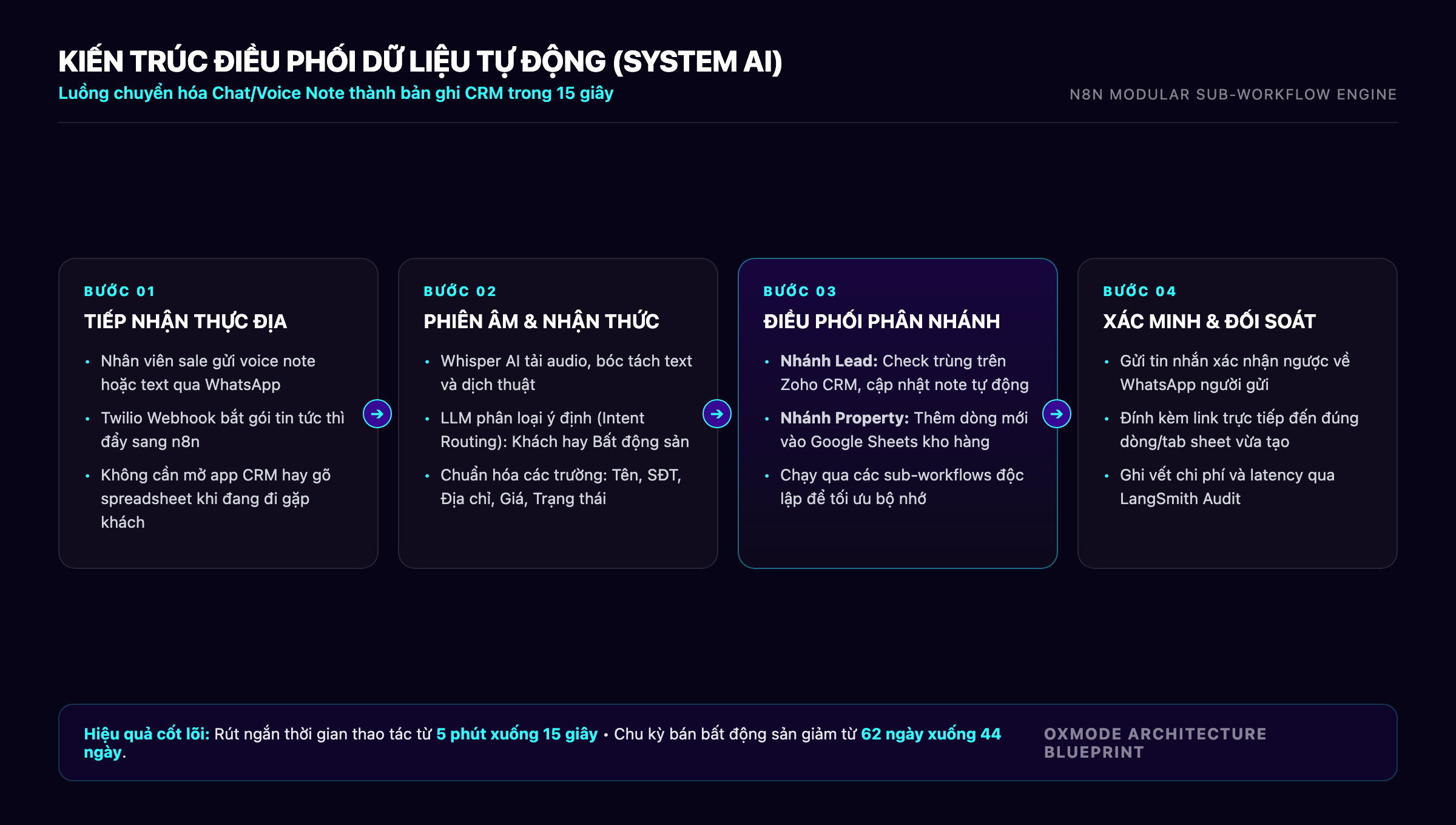
The architectural blueprint is partitioned into four decoupled layers:
Layer 1: Multi-Modal Field Ingestion
Upon departing a property inspection, a sales broker simply records a 30-second audio voice note or texts a concise summary to the internal business number. Utilizing Twilio webhooks bound to n8n, the pipeline ingests the raw payload instantly without manual dispatching.
Layer 2: Automated Transcription and Cognitive Intent Classification
The core n8n workflow evaluates the payload format. When an audio memo arrives, n8n orchestrates automated retrieval and dispatches the file to OpenAI’s Whisper engine for high-fidelity transcription.
Subsequently, a specialized Large Language Model parses the resulting text against strict operational schemas:
- Entity Extraction: Prospect name, contact phone, property physical address, requested valuation, specifications, and special transaction contingencies.
- Intent Routing: Dynamically segregates requests into Commercial Inbound Leads or Master Property Catalog Additions.
Layer 3: Partitioned Sub-Workflows for Resilient Execution
To guarantee modularity and isolate memory overhead, System AI decoupled execution logic into dedicated sub-workflows:
- Lead Pipeline: n8n queries Zoho CRM via API to detect existing contact records. If a duplicate exists, it appends updated consultation notes; if absent, it instantiates a fresh lead record.
- Property Catalog Pipeline: n8n maps property dimensions and valuation data directly into designated tabs within the master Google Sheets asset tracker.
Layer 4: Traceable Verification via Direct Navigation Links
The most decisive usability feature in System AI’s implementation is immediate bi-directional verification: Once writes are finalized, n8n generates an automated confirmation message back into the broker's chat thread, embedding a direct hyperlink pointing to the specific spreadsheet row or CRM record just created.
Brokers verify accuracy with a single tap in under two seconds. Complete operational confidence is established without requiring follow-up phone calls or manual back-office status queries.
3. Quantified Business Impact Across Production Operations
Transitioning from manual transcription to automated pipeline orchestration generated immediate, measurable dividends across The Srama Group's operational metrics:
- 97% Reduction in Task Latency: Administrative task duration plummeted from an average of four to five minutes down to 10 to 20 seconds.
- One Full Workday Recovered Weekly: Every operational team member recovered approximately eight hours per week previously consumed by mechanical transcription.
- Sales Cycle Compressed from 62 to 44 Days: End-to-end velocity from initial listing onboarding to completed transaction contracted by 18 full days (nearly a 30% improvement). In commercial brokerage, an 18-day acceleration in asset turnover dramatically increases capital liquidity.
- Staff Optimization: Virtual assistants previously hired for repetitive transcription were transitioned into customer-facing nurturing and transaction closing support.
- Commercial Agency Compounding: For System AI, self-hosted n8n evolved into their foundational delivery stack, generating over 70% of total agency revenue across enterprise clients worldwide.
4. Strategic Implementation Rules for Vietnamese SMEs
From our enterprise systems advisory experience at OXMODE, the System AI case study yields three foundational principles for growing organizations in Vietnam:
-
Deploy Input Interfaces Where Teams Already Operate (Chat-First Operations): In Vietnam, commercial sales agents across real estate, manufacturing, and distribution operate almost exclusively inside Zalo and chat channels. Forcing them to open complex desktop software after client meetings inevitably creates adoption resistance. Integrating automation directly into chat environments removes administrative friction.
-
Always Pair Automation with Traceable Verification Links: Corporate AI initiatives frequently fail due to human mistrust of automated data writes. By delivering direct hyperlinks to newly created database records back to the operator, employees verify accuracy in seconds, creating high operational trust.
-
Convert Static Administrative Expenses into Dynamic Revenue Capacity: The ultimate purpose of workflow automation is not aggressive head-count reduction, but the elimination of unproductive busywork. By liberating staff from copy-paste drudgery, organizations redirect valuable human energy toward customer relationships, strategic negotiation, and measurable revenue growth.