When an e-commerce enterprise scales from 25 to 350 employees, the default executive instinct is to procure software. Every operational friction in warehousing, customer support, or digital marketing is met with another specialized SaaS subscription.
Over time, an expensive pattern takes root: software licensing costs escalate, corporate data fragments into isolated functional silos, and knowledge workers dedicate substantial portions of their workdays exporting CSVs from one platform simply to upload them into another.

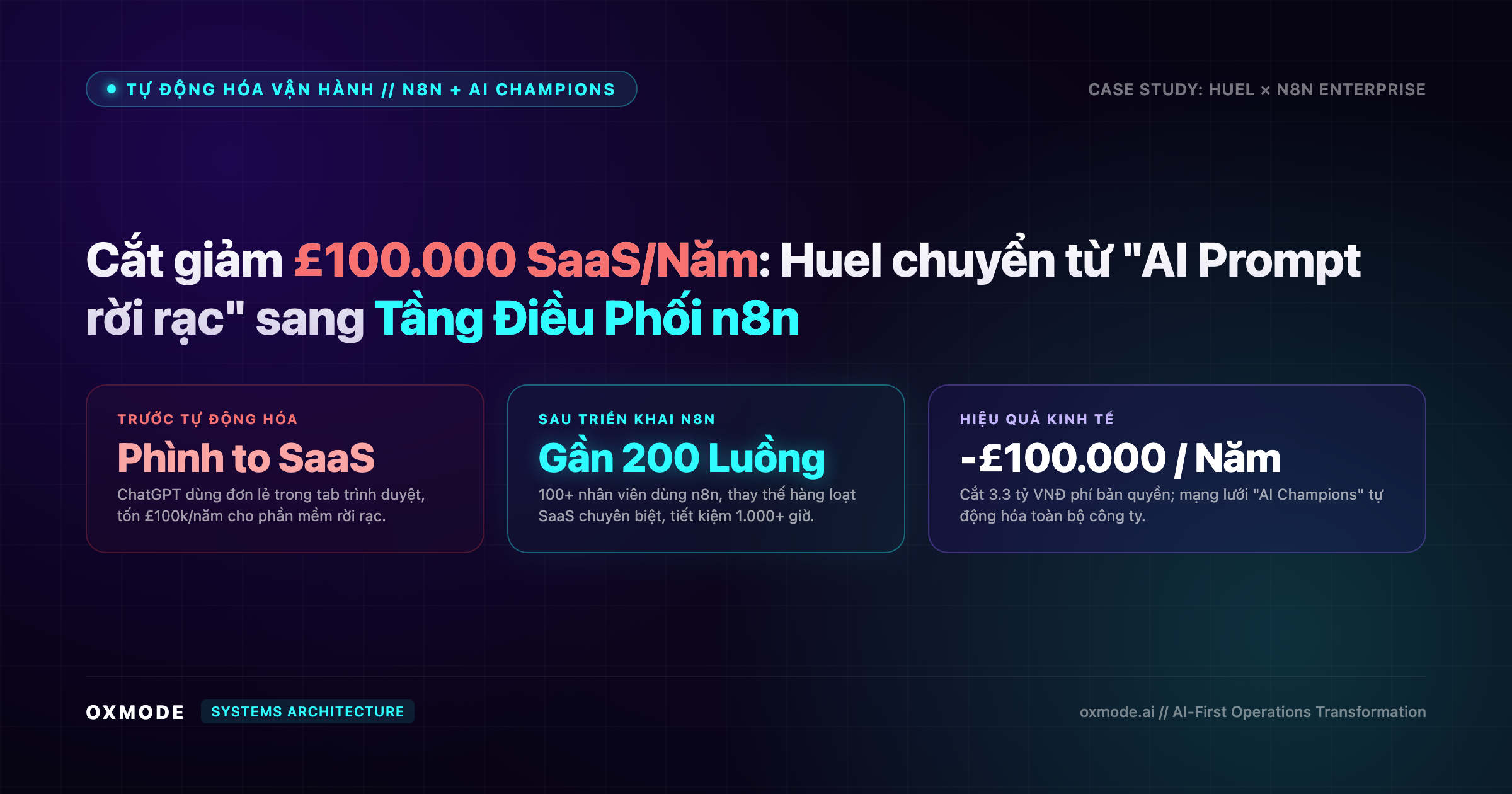
Huel, a global nutrition brand headquartered in the United Kingdom, navigated this exact inflection point. When large language models gained widespread prominence, Huel’s workforce enthusiastically adopted conversational prompting tools like ChatGPT. However, Chief Technology Officer Ollie Scheers quickly diagnosed a critical structural ceiling: operational value remained strictly confined within individual browser tabs.
There was no enterprise-grade mechanism to integrate artificial intelligence directly into corporate data pipelines, financial reconciliation workflows, or marketing asset production without demanding prohibitive custom engineering investments. Concurrently, the cumulative financial overhead of single-purpose software subscriptions was becoming unsustainable.
To break through this constraint, Huel executed a decisive strategic shift: retiring fragmented SaaS tools in favor of n8n Enterprise as a central Orchestration Layer, operationalized through an internal AI Champions organizational framework.
1. The Three Structural Pillars of Huel's AI Operating Model
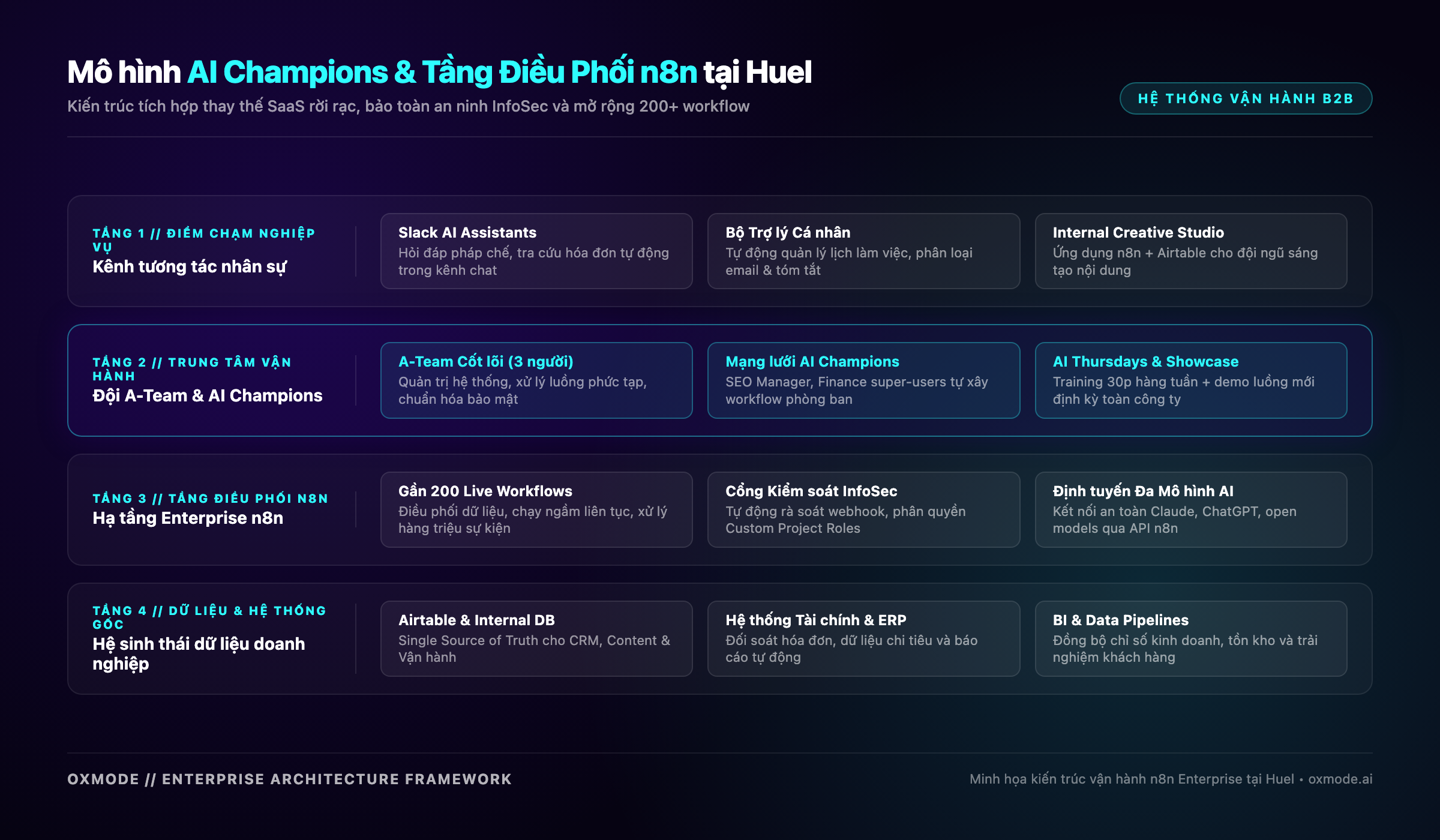
Rather than assembling an unwieldy technical department, Huel maintains a lean core automation team of just three full-time specialists (internally designated the A-Team). The scalability of the initiative relies upon three architectural pillars:
HUEL ENTERPRISE AI OPERATING ARCHITECTURE

┌─────────────────────────────────────────────────────────────┐
│ 1. BUSINESS CHANNELS (Slack AI Bots, Personal Assistants)   │
├─────────────────────────────────────────────────────────────┤
│ 2. CENTRAL ORCHESTRATION LAYER (n8n Enterprise Cluster)     │
│ ~200 Workflows • InfoSec Webhook Gate • Multi-LLM Routing   │
├─────────────────────────────────────────────────────────────┤
│ 3. ENTERPRISE DATA FABRIC (Airtable, Financial ERP, BI)     │
└─────────────────────────────────────────────────────────────┘
Pillar 1: The Distributed "AI Champions" Network
While the centralized technical team establishes infrastructure protocols, enforces data governance, and handles complex architectural integrations, domain-level workflow design is executed by operators embedded directly within business units.
The trajectory of Craig, Huel’s SEO Manager, exemplifies this operational transition. Craig mastered n8n over a single weekend. Utilizing visual node-based logic, he automated repetitive keyword extraction, performance auditing, and content analysis. The resultant efficiency liberated so much capacity that Craig now allocates three to four days per week collaborating alongside the central automation unit to engineer scalable workflows across digital marketing and creative departments.
A parallel dynamic unfolded within corporate finance, where an operational super-user redirected approximately 90% of their working hours toward automating invoice reconciliation and ledger matching.
Pillar 2: Institutional Rhythms: "AI Thursdays" and Bi-Weekly Showcases
Cultural inertia is frequently the primary barrier to technological adoption. Huel instituted two recurring programmatic cadences:
- AI Thursdays: Focused, 30-minute weekly instructional seminars accessible to all corporate personnel, covering practical API connectivity and automated data handling.
- Bi-Weekly AI Showcases: An institutional forum held every two weeks during company-wide assemblies, wherein non-technical staff present live workflow solutions they personally engineered in n8n. Observing a peer automate inventory audits or lead triage dissolves intimidation, prompting cross-functional teams to experiment with their own workflows.
Pillar 3: Automated InfoSec and Webhook Governance
A common hazard in citizen development programs is the emergence of unmonitored shadow IT, generating compliance vulnerabilities and credential leakage.
Huel neutralized this risk through programmatic governance: the central team constructed an automated surveillance workflow leveraging the n8n API in tandem with Airtable. Whenever an employee configures an external webhook listener, an automated inspection alert dispatches to the Information Security (InfoSec) department for credential auditing prior to production activation. Coupled with Custom Project Roles, this architecture balances decentralized builder empowerment with rigorous security boundaries.
2. Quantified Economic Return: £100,000 Saved and 1,000+ Manual Hours Eliminated
Within nine months of deploying n8n Enterprise, Huel recorded tangible operational returns:
- £100,000+ in Annual SaaS Subscription Savings: Huel systematically eliminated multiple single-purpose, high-cost software licenses, replacing them entirely with internal workflows constructed on n8n.
- Over 1,000 Hours of Manual Labor Recovered: Routine clerical tasks—including cross-system data reconciliation, operational alert propagation, and scheduled reporting—now execute autonomously.
- Accelerated Workflow Trajectory: Expanding from five initial validation proofs-of-concept, the environment scaled to 75 active production workflows within six months, presently approaching 200 production workflows.
- 100+ Active Builders Across the Workforce: Nearly one-third of the global organization actively constructs or interacts with automated AI workflows on a daily basis.
- Proprietary Internal Application Development: Leveraging n8n paired with Airtable, Huel developed bespoke operational platforms in-house, including a centralized Creative Studio, customer sentiment intelligence engines, and cross-departmental project trackers.
3. Strategic Takeaways for Growing Enterprises
From OXMODE’s systems advisory practice, Huel’s operational trajectory offers three strategic directives for modern organizational leadership:
-
Halt Fragmented SaaS Procurement Without an Orchestration Backbone: Every standalone application purchased introduces another data silo and recurring balance sheet liability. Prior to committing to specialized software vendors, evaluate whether an enterprise orchestration layer can synthesize existing systems at a fraction of the capital expense.
-
Empower Domain Champions Over Monolithic IT Queues: Funneling every operational adjustment through a centralized software development backlog paralyzes enterprise velocity. Identify forward-thinking operators within functional business units, equip them with visual workflow orchestrators, and empower them to automate their own operational bottlenecks.
-
Anchor Artificial Intelligence Within Systems, Not Isolated Prompts: Conversational interfaces in isolated browser sessions deliver localized, uncompounded benefits. Real enterprise leverage occurs when language models are connected directly via orchestration pipelines to relational databases, ERP backends, and daily communication channels.