
In B2B commerce, response latency directly dictates deal velocity.
Yet for organizations managing extensive product catalogs with high customization requirements, generating tailored commercial proposals remains a punishing administrative bottleneck. Sales representatives routinely function as warehouse inventory clerks, copywriters, and presentation layout designers simply to furnish a single prospect with a commercial pitch deck.

BeGlobal, a Dutch enterprise specializing in branded corporate gifts for multinational organizations, encountered this operational ceiling firsthand. Managing a catalog of over 100,000 product stock-keeping units (SKUs), every client engagement demands bespoke curation: matching seasonal themes (Christmas, Easter, corporate anniversaries), adhering to strict per-unit budgets, and aligning with client brand palettes.
Historically, producing an individual proposal required a laborious sequence:
- Manually filtering product entries across fragmented databases and CRM records.
- Sourcing high-resolution imagery and manually compositing product mockups onto event-themed backgrounds.
- Writing copy specifications, validating unit prices, and formatting slides inside PowerPoint.
This workflow demanded several hours per proposal. Consequently, BeGlobal was restricted to producing roughly 50 proposals annually. The growth constraint was not customer demand, but internal deck production bandwidth.
To dismantle this operational constraint, BeGlobal partnered with PromptGorillas—an AI systems integration firm founded by Lars van Gils—to architect an automated commercial offer generation engine orchestrated entirely via n8n.
1. The 4-Layer Architecture: From Conversational Intake to Complete Presentation in 52 Seconds
Rather than attempting to construct an opaque, monolithic black-box application, PromptGorillas partitioned the technical solution into four resilient, modular layers:
BEGLOBAL COMMERCIAL PROPOSAL GENERATION PIPELINE

┌─────────────────────────────────────────────────────────────┐
│ 1. CONTEXTUAL INTAKE (Custom Frontend via Cursor)           │
│ Chat agent captures: Occasion • Budget • Brand Identity     │
├─────────────────────────────────────────────────────────────┤
│ 2. COGNITIVE ORCHESTRATION & SQL AI (n8n Engine)            │
│ GPT Agent generates precise SQL • Code nodes filter CRM     │
├─────────────────────────────────────────────────────────────┤
│ 3. CATALOG QUERY & GENERATIVE MOCKUPS (Supabase & Nano Banana)│
│ Search 100k items • Render contextual theme backgrounds     │
├─────────────────────────────────────────────────────────────┤
│ 4. AUTOMATED PRESENTATION ASSEMBLY (Google Slides API)      │
│ Clone master templates • Inject specs & images • Ship in 52s│
└─────────────────────────────────────────────────────────────┘
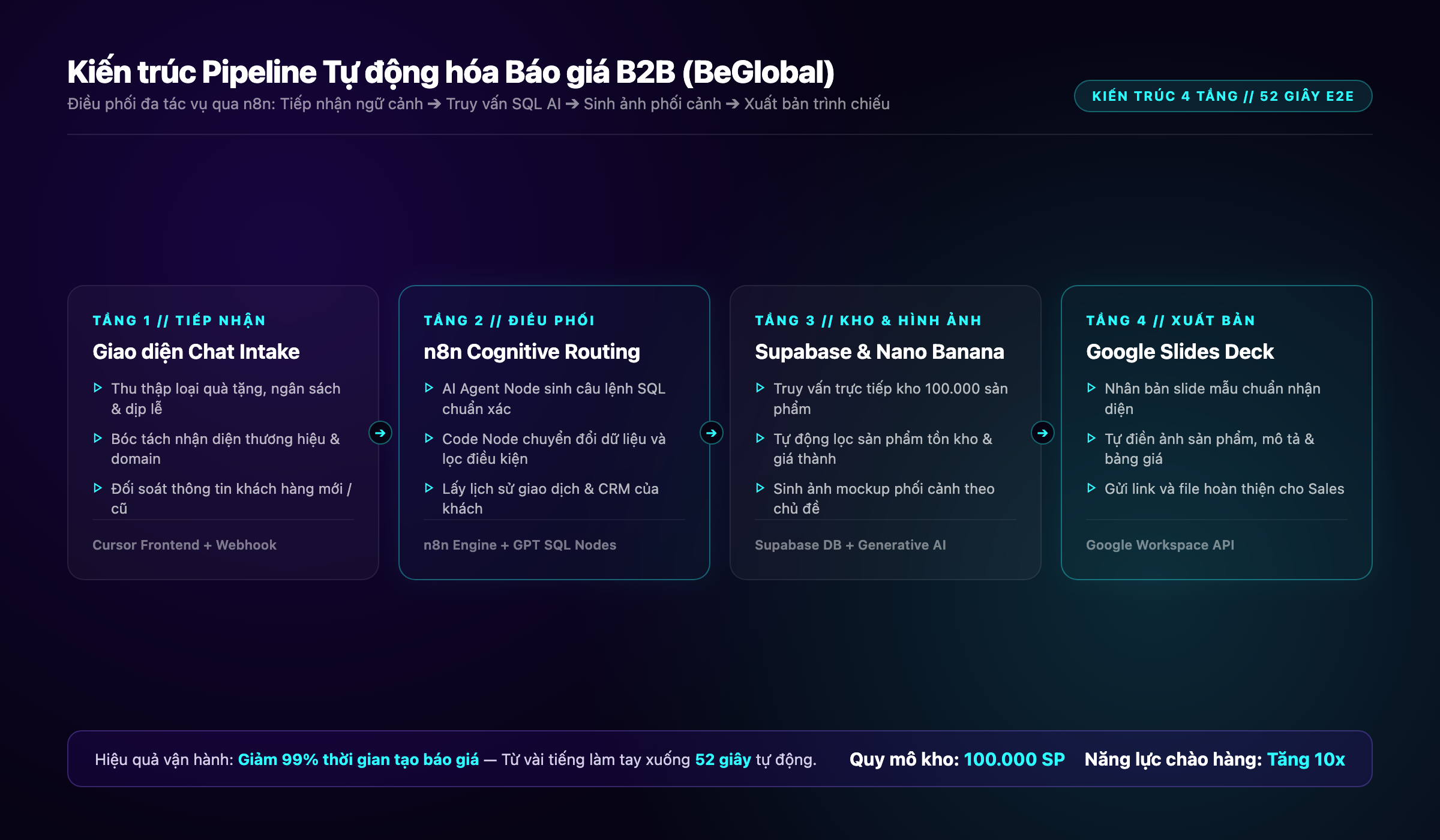
The end-to-end pipeline operates sequentially across four distinct tiers:
Layer 1: Contextual Conversational Intake
Sales operators no longer navigate spreadsheets or inventory software. They interact with an intuitive chat agent on an internal interface built with Cursor. The agent collects essential project parameters:
- What occasion is the package celebrating (Christmas, spring gifting, onboarding)?
- What is the maximum budget allowance per individual recipient?
- What is the prospect's corporate entity name and primary web domain?
- Is this a new prospect or an existing account with historical purchase data?
Once the parameters are verified, the frontend dispatches a webhook event into the n8n execution environment.
Layer 2: Cognitive Orchestration and SQL Synthesis
Upon receiving the payload, n8n invokes specialized sub-workflows:
- If the account exists historically, n8n queries the CRM database to inspect past product preferences and brand guidelines.
- To interrogate the catalog of 100,000 products housed in Supabase, an AI Agent node works in tandem with custom Code nodes to generate optimized SQL queries, filtering for inventory availability, pricing thresholds, and color attributes.
Layer 3: Dynamic Themed Visual Generation with Nano Banana
Raw catalog images are typically isolated white-background product shots. Inserting bare cutouts into seasonal corporate presentations creates an uninspired impression.
n8n extracts the shortlisted product image URLs and transmits them to Nano Banana via API. The generative image system places the product into appropriate holiday environments—complete with atmospheric lighting, festive textures, and gift packaging—eliminating hours of graphic design turnaround.
Layer 4: Automated Assembly in Google Slides
In the concluding stage, n8n interacts with a standardized master template residing in Google Drive:
- Dynamically clones the layout structures matching the number of selected products.
- Injects generated mockup imagery, technical descriptions, unit tiers, and total cost calculations into designated layout containers.
- The entire process—from conversational intake to final presentation generation—executes in 52 seconds.
2. Quantified Business Impact: A 10x Increase in Commercial Proposal Velocity
Deploying an orchestrated automation layer permanently altered BeGlobal's unit economics:
- Turnaround Compressed from Hours to 52 Seconds: Administrative labor was completely removed from the sales workflow. Generating an enterprise proposal now requires under two minutes of human engagement.
- Proposal Capacity Expanded 10x: Liberated from presentation authoring, BeGlobal transitioned from its historical cap of 50 offers per year to generating hundreds of proposals annually without expanding back-office headcount.
- Historical Data Utilization: Client engagement history is automatically surfaced and incorporated into every fresh interaction.
- Future-Proof Modular Adaptability: When new generative image models emerge, n8n’s modular node framework allows immediate pipeline integration without requiring system rewrites.
3. Strategic Takeaways for B2B Enterprises
From our automation engineering practice at OXMODE, the BeGlobal transformation offers three practical principles for commercial organizations:
-
Sales Bottlenecks Are Frequently Information Packaging Problems: Sales underperformance rarely stems from an inability to converse with clients; it stems from spending 70% of working hours formatting presentations, gathering product specs, and calculating price matrices. Eliminating administrative friction immediately expands sales velocity.
-
Decouple the User Interface from the Orchestration Engine: Avoid purchasing expensive, rigid enterprise software suites. Pair lightweight frontend interfaces with robust relational databases, and position n8n as the central orchestrator connecting operational logic.
-
Automation Must Deliver High-Fidelity Visual Artifacts: Sending prospects raw text tables rarely builds conviction. By pairing structured database queries with generative image styling and automated slide deck production, deliverables arrive fast, elegant, and ready for executive sign-off.