
As enterprises expand, data fragmentation across operational departments becomes an unavoidable structural reality.
Particularly across market research, financial services, and consumer intelligence sectors, data repositories inevitably scatter across disparate architectures: distributed batch computation clusters, social trend extraction APIs, customer relationship management databases, and heterogeneous cloud environments.

Quid, an enterprise consumer and market intelligence platform serving multinational organizations across North America, Europe, Asia, and Australia, encountered this structural wall.
Historically, technical development at Quid flowed exclusively through the core engineering department. Cross-continental time-zone friction created persistent latency in responding to commercial requirements:
- An afternoon client briefing in the United States often waited until the following Asian business day to translate into technical scoping.
- Specialized research analysts dedicated an average of six hours per market report. A single recurring deliverable—the Commerce Factory report—consumed two full-time analysts for nearly an entire working week.
- Validating product concepts via proof-of-concept (POC) builds frequently absorbed weeks or months of engineering runway.
Conventional enterprise consulting typically suggests a heavy remedy: initiate a multi-year Data Lakehouse consolidation program to unify storage at the persistence layer. For Quid, that route represented millions of dollars in capital expenditure, multi-year delivery timelines, and massive operational disruption.
Rather than consolidating storage, Quid’s leadership adopted an agile strategy: Deploy an enterprise Orchestration Layer powered by self-hosted n8n to compose data capabilities dynamically at the point of customer engagement.
1. The Three Technical Pillars of Quid’s Orchestration Layer
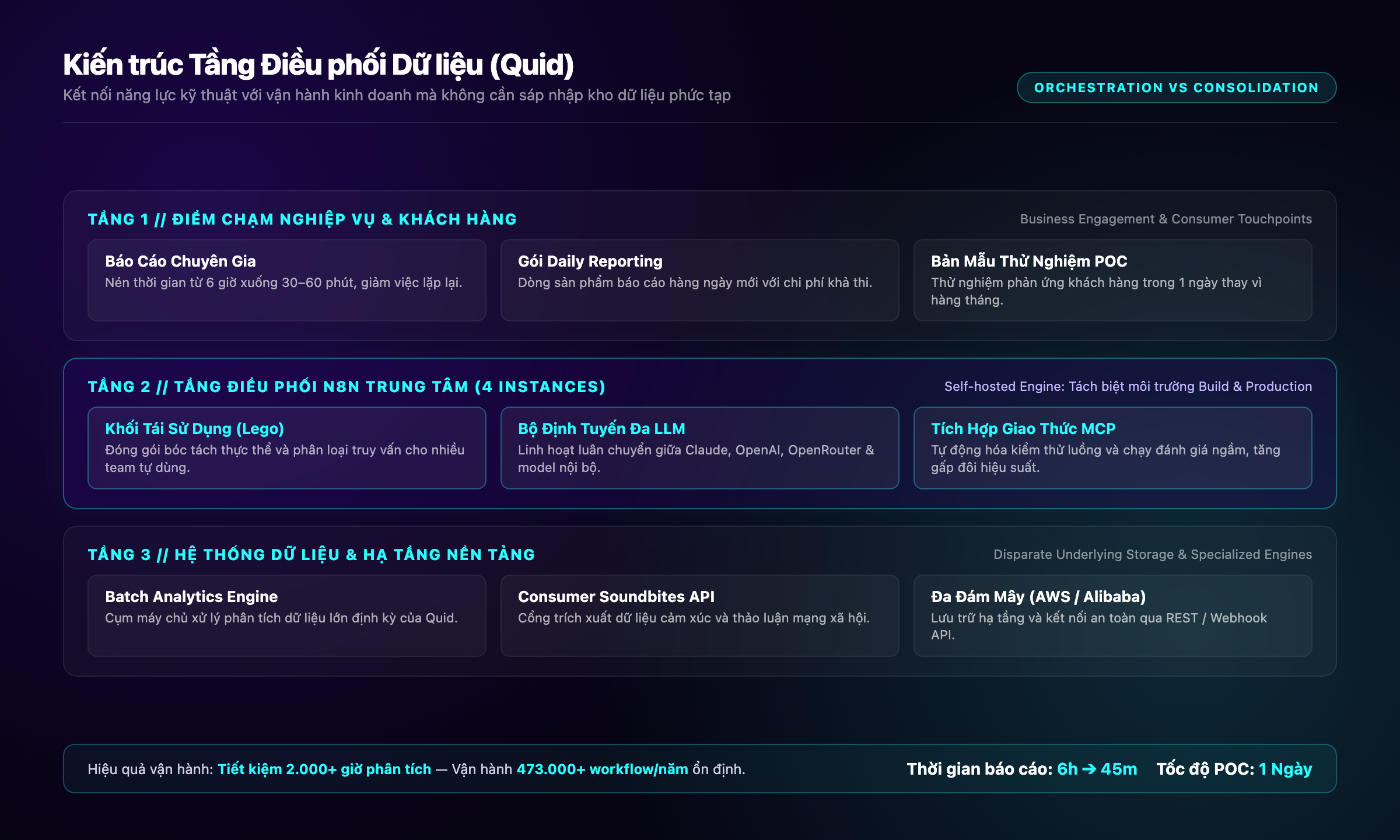
To ensure institutional stability, Quid deployed n8n across four dedicated self-hosted instances, strictly separating build environments from mission-critical production pipelines.
The technical architecture rests upon three operational pillars:
QUID ENTERPRISE ORCHESTRATION ARCHITECTURE

┌─────────────────────────────────────────────────────────────┐
│ 1. BUSINESS TOUCHPOINTS & CLIENT DELIVERABLES               │
│ Specialist Reports • Daily Reporting Tier • 1-Day POC Builds│
├─────────────────────────────────────────────────────────────┤
│ 2. CENTRAL N8N ORCHESTRATION LAYER (4 Self-Hosted Instances)│
│ Composable Blocks • Multi-LLM Routing • Automated MCP Eval  │
├─────────────────────────────────────────────────────────────┤
│ 3. HETEROGENEOUS BACKEND SYSTEMS & CLOUD INFRASTRUCTURE     │
│ Batch Analytics Engine • Soundbite APIs • Multi-Cloud Storage│
└─────────────────────────────────────────────────────────────┘
Pillar 1: Composable Building Blocks
Rather than developing bespoke, single-use integrations for each departmental request, Quid’s software engineers package capabilities into modular n8n workflow blocks.
A primary example is fine-grained entity extraction within social media conversations: moving beyond broad category detection (such as "athletic footwear") to extract specific shoe editions, sponsoring athletes, emotional sentiment indicators, and user environments. Engineering constructed this capability once and exposed it as an n8n module. It now powers five distinct AI agents across three enterprise clients, compounding engineering ROI without requiring ongoing code intervention.
Pillar 2: Vendor-Agnostic Multi-LLM Routing
Quid deliberately avoided single-provider dependency. All language model interactions are routed and governed through n8n.
The orchestration layer dynamically arbitrates requests across in-house proprietary models, Anthropic's Claude, OpenAI's GPT models, and external open-weights architectures via OpenRouter. When an innovative model enters the global market, Quid benchmarks and deploys it into live workflows without renegotiating procurement agreements or undergoing months of security audits.
Pillar 3: Integration Testing via Model Context Protocol (MCP)
As workflow volume expanded into hundreds of thousands of executions, pipeline evaluation became critical. Quid integrated the Model Context Protocol (MCP) directly into its orchestration stack.
Engineers connect Claude directly to n8n’s MCP endpoints to author automated integration test suites and execute background evaluations, effectively doubling engineering testing throughput while maintaining rigorous quality standards.
2. Measurable Operational Outcomes: 473,000 Executions and a New Revenue Stream
Over twelve months of production deployment, Quid achieved profound leverage:
- 473,000+ Annual Workflow Executions: The orchestration cluster maintains high availability across build and production instances.
- 2,000+ Analyst Hours Recovered: Specialized analysts redirected hundreds of hours previously consumed by manual data compilation toward strategic advisory and client-facing interpretation.
- Report Turnaround Slashing from 6 Hours to Under 60 Minutes: Market analysis generation cycles contracted by 85% to 90%.
- Weekly Reporting Process Reduced to Hours: The Commerce Factory workflow, which formerly immobilized two analysts for a full week, now executes autonomously in a few hours across three days.
- Proof-of-Concept Acceleration to 24 Hours: Prototyping speed compressed from multiple weeks to a single business day (with working prototypes assembled in as little as 30 minutes).
- Invention of the Daily Reporting Commercial Tier: High-frequency daily reporting was commercially unviable under manual analyst economics. The orchestration engine enabled Quid to package and monetize daily intelligence as a lucrative, scalable subscription tier.
3. Strategic Governance Principles for Modern Enterprises
From OXMODE’s systems advisory practice, Quid’s transformation provides three essential principles for organizational leadership:
-
Prioritize Orchestration Over Storage Consolidation: Do not commit substantial capital to multi-year database unification projects before testing actual delivery needs. Permit specialized platforms to maintain their optimal data models, and deploy an orchestration layer to integrate information dynamically where business value is realized.
-
Transform Engineering Capabilities into Self-Service Modular Assets: When non-technical operators depend on software developers for routine workflow adjustments, enterprise velocity stagnates. Package engineering APIs into reusable, visual modules that operational teams can assemble independently.
-
Compress Market Learning Loops with Rapid Prototyping: The highest cost in digital transformation is building capabilities customers never purchase. Leverage visual orchestration tools like n8n to prototype client-facing workflows within hours, validate commercial appetite immediately, and allocate production engineering capital only where demand is proven.