
In omnichannel retail and e-commerce operations, synchronization latency between core Enterprise Resource Planning (ERP) databases and online storefronts represents a continuous source of friction.
When purchase costs fluctuate, promotional tiers trigger, or inventory levels shift, these updates must reflect instantly across customer-facing catalogs. If data plumbing bottlenecks, customers encounter outdated pricing, place orders for out-of-stock items, or companies inadvertently absorb margin losses from outdated discount matrices.
For retail operations managing tens of thousands of SKUs across multi-tier B2B and B2C customer groups, weekly pricing record mutations routinely reach into the millions.
iMi digital GmbH—a German technology agency supporting e-commerce infrastructure across a retail group established in 2000—faced this exact data volume challenge. They develop and maintain high-traffic e-commerce operations on Shopware and Magento, tightly integrated with enterprise ERP backends.
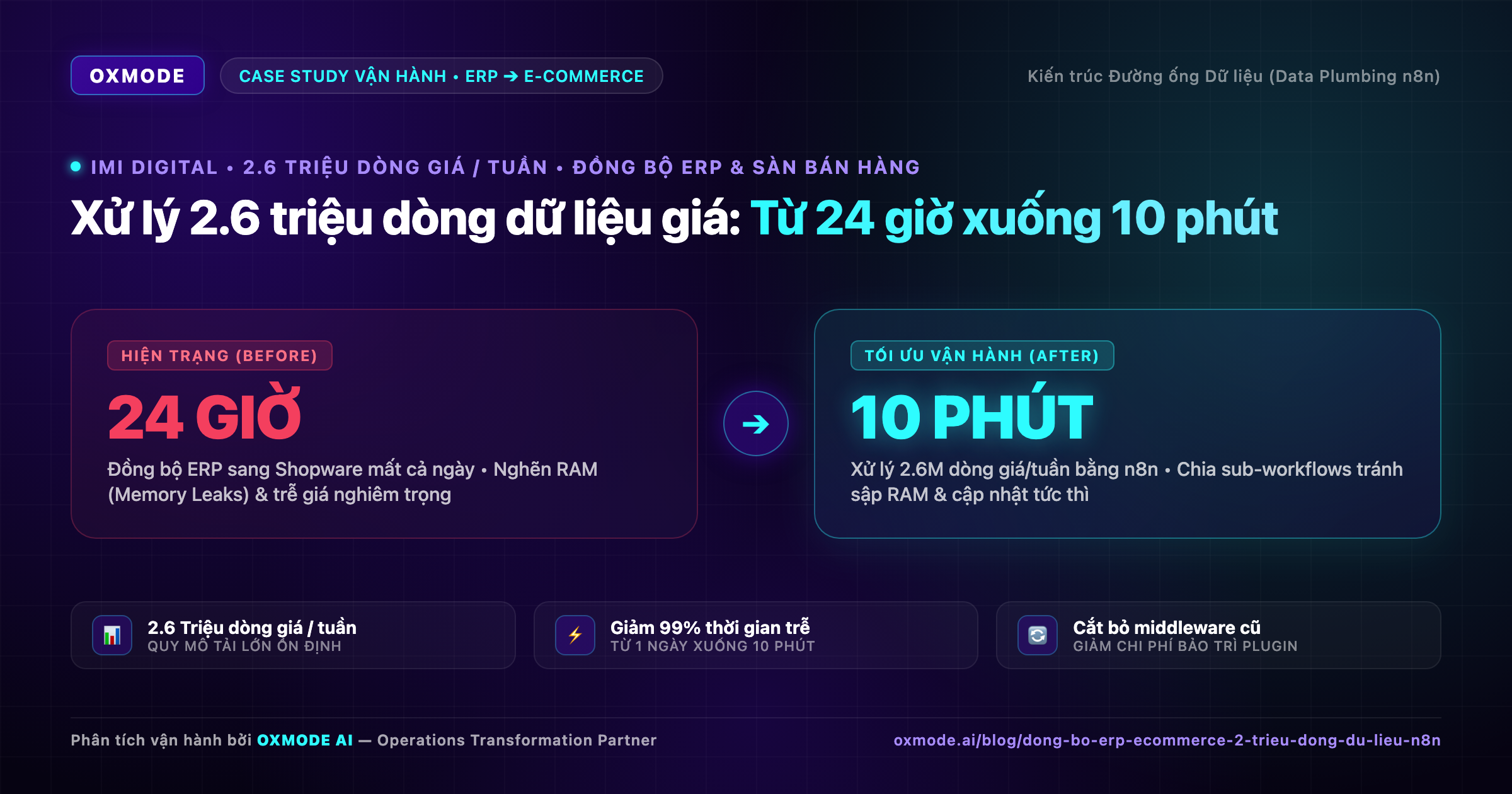
An earlier importer engineered by an external third-party vendor required nearly a full day (approximately 24 hours) to execute a complete synchronization run. The process frequently crashed from memory leaks, delaying critical commercial pricing updates.
By re-architecting their data integration pipelines around self-hosted n8n, iMi digital achieved dramatic efficiency milestones:
- Sync Duration: Slashed full catalog update cycles from 24 hours down to approximately 10 minutes (a 99% reduction in latency).
- Processing Scale: Reliably processes 2.6 million price rows per week with zero server memory crashes.
- Maintenance Overhead: Replaced fragile, custom-coded middleware plugins with auditable, visual workflows that adapt smoothly across e-commerce platform version upgrades.
- Operational Compound Value: Automated marketing data transfers from core databases directly into CRM and Mautic marketing segments, eliminating dozens of hours of manual copy-pasting every month.

1. The Memory Leak Nightmare in High-Volume Synchronization
Prior to adopting n8n, iMi digital maintained an integration architecture reliant on custom-coded PHP middleware.
As the retail business scaled, catalog export files from the ERP grew exponentially heavier. Pricing was not a single flat number; it multiplied across customer tiers, wholesale volume tiers, regional currencies, and promotional campaigns. Weekly pricing fluctuations reached roughly 2.6 million individual rows.
Whenever legacy middleware attempted to parse and load these massive datasets into memory within a single execution block, server RAM exhausted rapidly. Execution dragged across 24 hours, locking server resources and preventing critical price changes from reflecting on the live storefront.
Furthermore, every time the e-commerce platform released a major version update, developers had to rewrite custom integration plugins. Maintaining these brittle interfaces consumed significant engineering hours, pulling PHP developers away from building strategic revenue-generating features.
2. High-Throughput Pipeline Architecture on n8n
To resolve the root bottleneck, Developer Team Lead Alexander Menk chose to migrate the synchronization engine to self-hosted n8n.
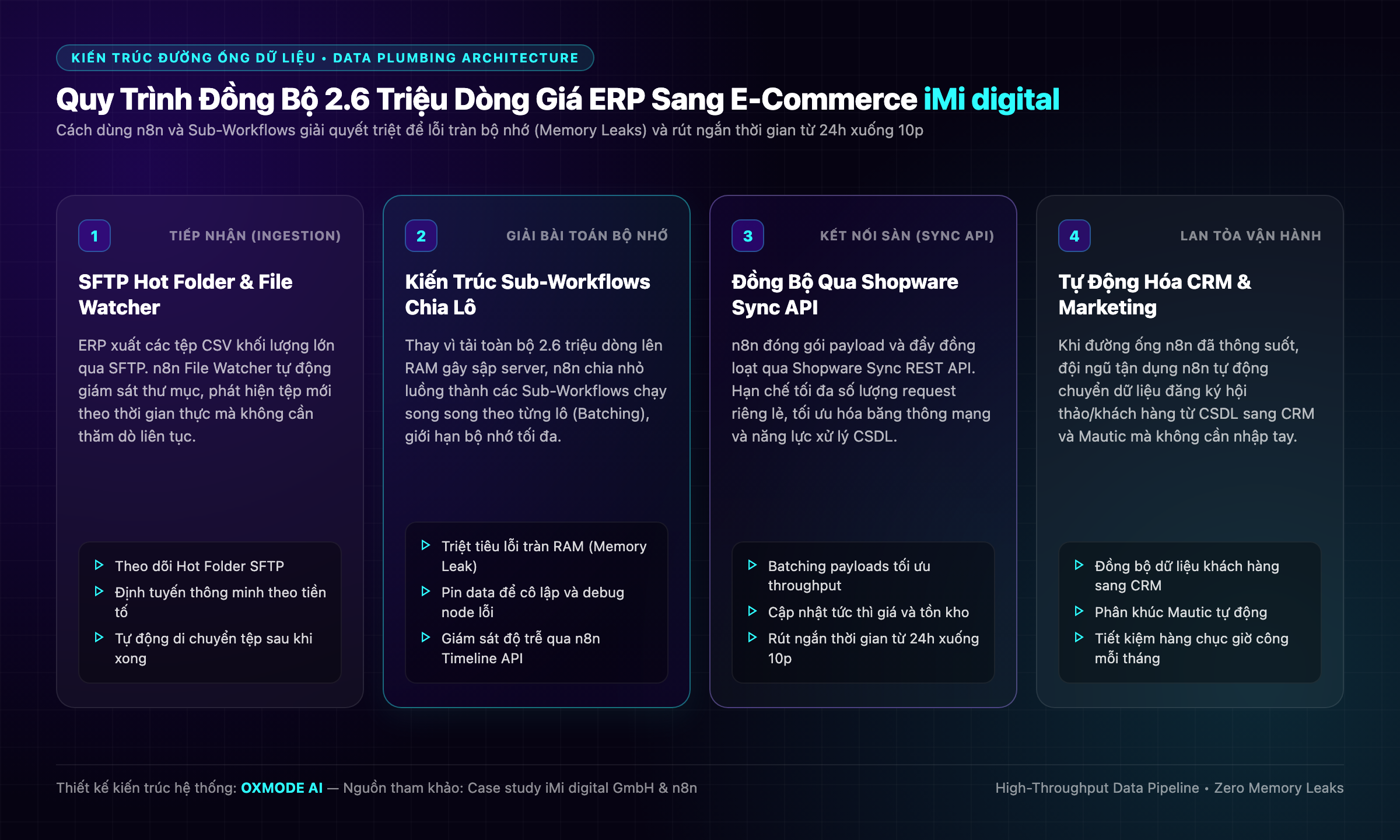
The new architecture operates around four core operational principles:
HIGH-THROUGHPUT DATA PIPELINE ARCHITECTURE (IMI DIGITAL)

┌─────────────────────────────────────────────────────────────┐
│ 1. HOT FOLDER INGESTION (SFTP File Watcher)                 │
│ Detect CSV exports in real-time • Route by filename prefix  │
├─────────────────────────────────────────────────────────────┤
│ 2. SUB-WORKFLOW PARTITIONING (Memory Protection)            │
│ Process in bounded batches • Zero memory leaks on large runs│
├─────────────────────────────────────────────────────────────┤
│ 3. BULK SYNCHRONIZATION (Shopware Sync REST API)            │
│ Batch HTTP payloads • Maximize network and DB throughput   │
├─────────────────────────────────────────────────────────────┤
│ 4. LATENCY OBSERVABILITY (n8n Timeline Analysis Tool)       │
│ Microsecond node profiling • Extend automations to CRM/Mktg│
└─────────────────────────────────────────────────────────────┘
Principle 1: Reactive Ingestion via File Watchers
The pipeline initiates with an n8n file watcher node monitoring a designated hot folder fed by CSV files from the ERP's SFTP server.
Based on filename prefixes (such as
products_customers_prices_Principle 2: Sub-Workflow Partitioning for RAM Protection
This technical pattern represents the most critical lesson for teams handling enterprise-scale data through workflow engines.
Rather than forcing 2.6 million records through a monolithic workflow—which inevitably causes memory bloat—iMi digital broke the logic into modular sub-workflows. The primary workflow segments incoming records into bounded batches and passes them sequentially to sub-workflows. Once a batch completes, its memory allocation releases immediately before the next batch initiates. This discipline keeps server memory usage flat and predictable throughout millions of rows.
Additionally, n8n’s native data-pinning capability enables developers to freeze execution state at specific nodes, drastically accelerating debugging whenever upstream API schemas vary.
Principle 3: Batched Ingestion via the Shopware Sync API
To push records into Shopware, the team avoided chatty single-item REST requests. They utilized the bulk Shopware Sync API, packing hundreds of mutations into batched payloads.
This batching strategy minimized HTTP handshake overhead, saturated available network throughput efficiently, and compressed full catalog syncs from a full 24-hour cycle down to roughly 10 minutes.
Principle 4: Granular Latency Profiling
To understand precisely where execution duration was concentrated beyond the standard user interface, Alexander Menk engineered an open-source performance profiling utility (publicly available on GitHub at
iMi-digital/n8n-timeline-analysisThe tool interfaces with n8n’s execution API to chart microsecond-level timing across individual nodes, allowing the engineering team to diagnose network and database bottlenecks systematically.
3. Operational Compound Value: Extending Pipelines to Marketing
Once the core n8n infrastructure proved stable, iMi digital quickly unlocked secondary operational dividends: extending workflow automation across business departments without licensing additional software.
A prime example was internal marketing data operations. Previously, when prospects registered for webinars or educational events, marketing personnel manually opened databases, transcribed participant records, and manually tagged contacts within CRM and Mautic marketing segments. Each participant required multiple minutes of manual data entry.
The technical team deployed a lightweight n8n workflow: the moment a new registration appears in the core database, n8n instantly synchronizes contact information into the CRM and segments the lead inside Mautic. This hands-off flow completely relieved marketing staff from repetitive data entry, saved dozens of hours each month, and ensured immediate email delivery to prospects.
4. Key Takeaways for Growing Retail Operations
From our operational transformation work at OXMODE, the iMi digital case surfaces three foundational rules for retail and e-commerce leaders:
- Fix Core Data Plumbing Before Pursuing AI: High-level AI initiatives collapse if fundamental operational data remains out of sync for 24 hours. Resilient, real-time data plumbing across inventory, pricing, and orders is the non-negotiable foundation of digital operations.
- Avoid the Trap of Proprietary Custom Plugins: Contracting developers to build bespoke, hardcoded integrations creates massive technical debt. When third-party platforms update their APIs, maintenance costs erode operational margins. Orchestration engines like n8n provide visual maintainability, lower debugging friction, and flexible business logic.
- Partition High-Volume Data into Bounded Batches: When transactional scale grows, never attempt to process millions of records in a single block. Segmenting data flows into sub-workflows and batched payloads is the only way to build systems that scale without crashing production servers.