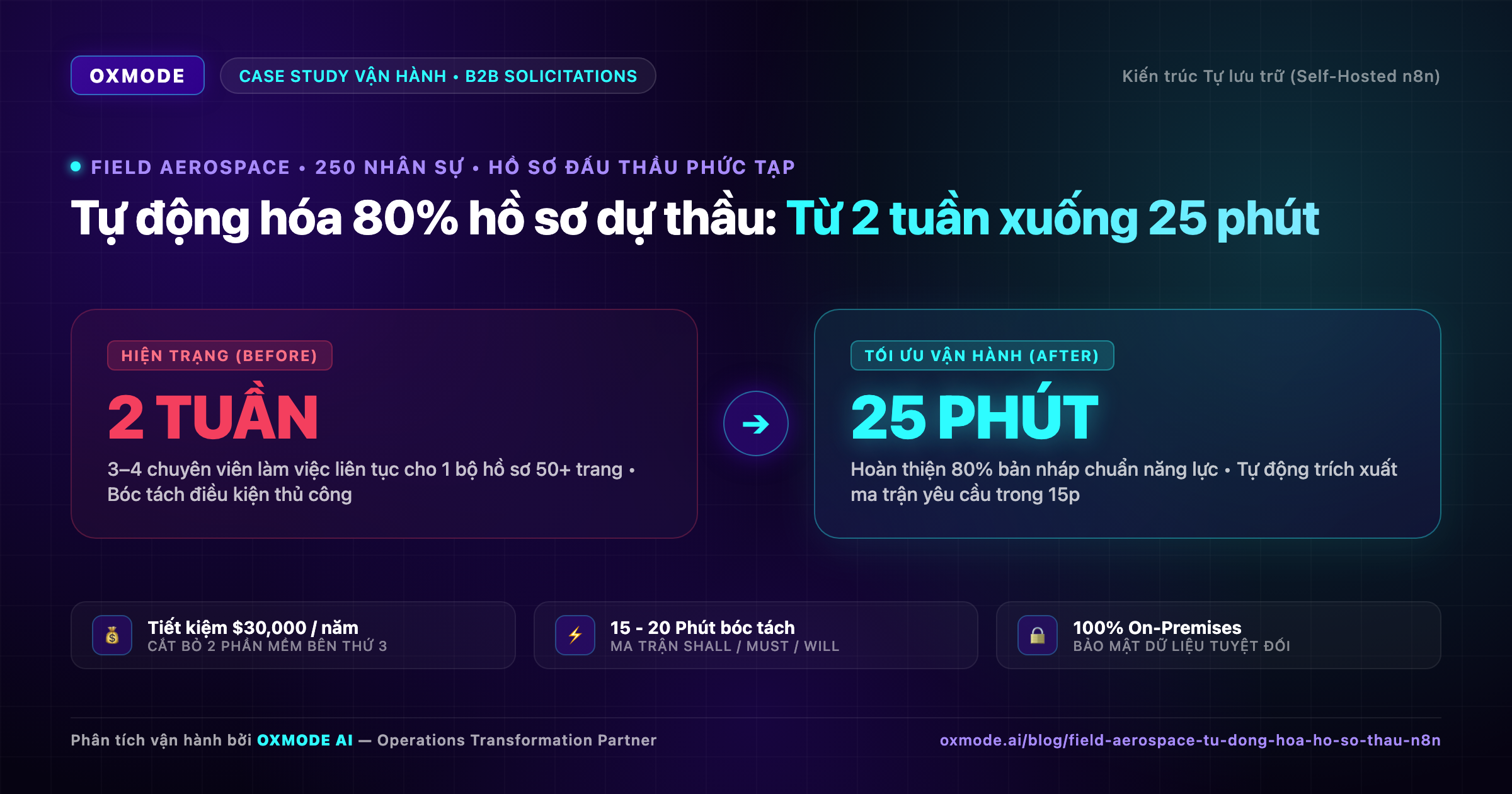
Executive Summary (Answer-First):
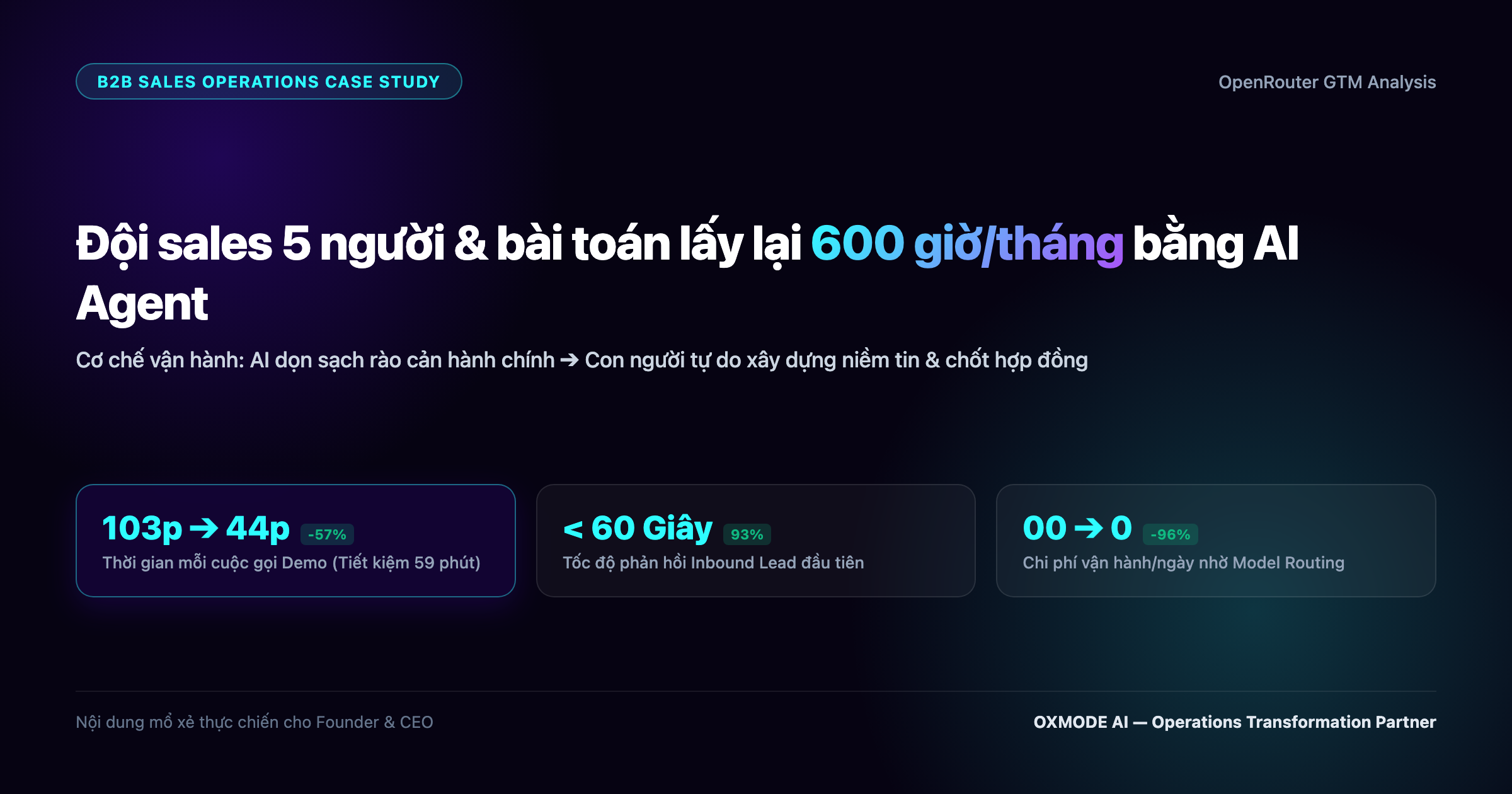
- The Problem: OpenRouter's 5-person sales team was overwhelmed by 600 administrative hours monthly spent on manual prospect research, meeting transcription, and CRM data entry.
- The Solution: Developed Rasp, an internal sales agent embedded directly inside Slack, automating 93% of first-touch inbound inquiries in under 60 seconds with cost-optimized model routing.
- Key Outcomes: Recovered 59 minutes per demo meeting, compressed deal cycles from 71 to 47 days (34% reduction), and slashed daily AI operational inference costs from ~00 to ~0.
| Operational Dimension | Manual Baseline (Pre-AI) | Rasp AI Sales Agent | Measured Improvement |
|---|---|---|---|
| Demo Prep & Meeting Synthesis | 103 minutes / call | 44 minutes / call | 59 minutes saved (57% reduction) |
| Initial Inbound Lead Triage | Multi-hour delay / lead rationing | Under 60 seconds (93% autonomous) | Sub-minute response, 7% human escalation |
| Sales Deal Cycle Duration | 71 days | 47 days | 34% cycle compression (24 days faster) |
| Daily AI Operational Cost | ~00 / day (frontier models) | ~0 / day (dynamic model routing) | 26x cost reduction |
| User Operational Interface | Disconnected web portals/tabs | Native Slack channels and threads | Zero workflow context switching |
The day-to-day reality of B2B sales is rarely as glamorous as management books suggest. High-performing sales representatives spend an uncomfortable portion of their work week not pitching or closing, but drowning in administrative paperwork.
Before a scheduled demo, they hunt through LinkedIn and corporate websites to understand the prospect's tech stack and company size. After the call, they sit through meeting recordings to compile written notes. Then comes the task almost every rep avoids: manually logging dozens of structured fields into the CRM. For every active opportunity, reps routinely sacrifice one to two hours simply keeping internal databases current.
In October 2026, OpenRouter published an internal case study tackling this exact operational bottleneck. Their entire sales organization consisted of just five people. When inbound inquiries surged alongside rapid business growth, the team found themselves overwhelmed by routine volume.
Rather than embarking on an aggressive hiring spree, they designed and shipped an internal AI agent called Rasp.
Within months, Rasp handed back approximately 600 working hours each month to the team, translating to roughly 28 hours recovered per representative. Deal cycles compressed by 34%, dropping from 71 days to 47. Most notably, daily system operating costs plummeted from nearly $800 during early prototypes down to roughly $30 per day.
Yet the primary insight from OpenRouter's experience is not simply the speed at which their metrics moved. It lies in their disciplined philosophy regarding the boundaries of automation, the architectural mistakes they discarded along the way, and the economics of deploying agents sustainably.
1. A Coarse File, Not a Closer
The name Rasp was deliberately chosen. In woodworking, a rasp is a rough-toothed tool used to shave away irregular material before a craftsperson steps in to polish the final piece.
OpenRouter framed their sales agent as precisely that: a coarse file. It does not run meetings, negotiate commercial terms, or attempt to close contracts. Its sole mandate is to sweep away administrative friction so sellers can operate at full speed.
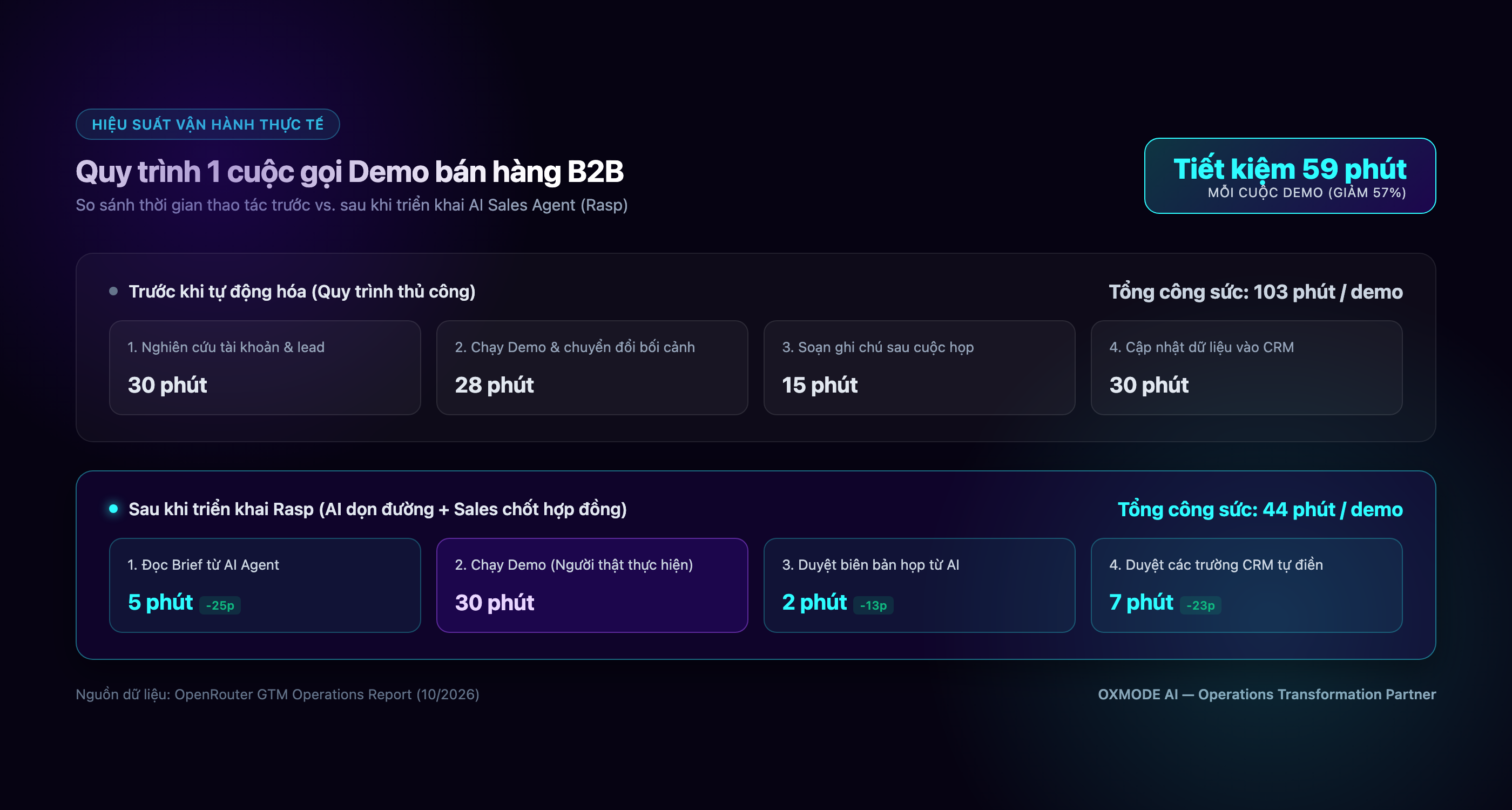
Historically, executing a single sales demo required approximately 103 minutes of combined labor: 30 minutes of account research, 28 minutes on the demo and context switching, 15 minutes drafting post-meeting synthesis, and 30 minutes updating CRM records.
With Rasp handling the prep and logging, that same workflow dropped to 44 minutes, eliminating roughly an hour of manual toil per meeting:
- Pre-demo briefing decreased from 30 minutes to 5, with the agent generating an executive brief beforehand.
- Post-call notes dropped from 15 minutes to 2, synthesized directly from transcripts.
- CRM updates fell from 30 minutes to 7, with the bot populating standard taxonomy fields automatically.
By removing this administrative drag, each representative gained enough capacity to take on two additional calls per day without compromising preparation rigor.
2. Sub-Minute Inbound and the 93% Rule
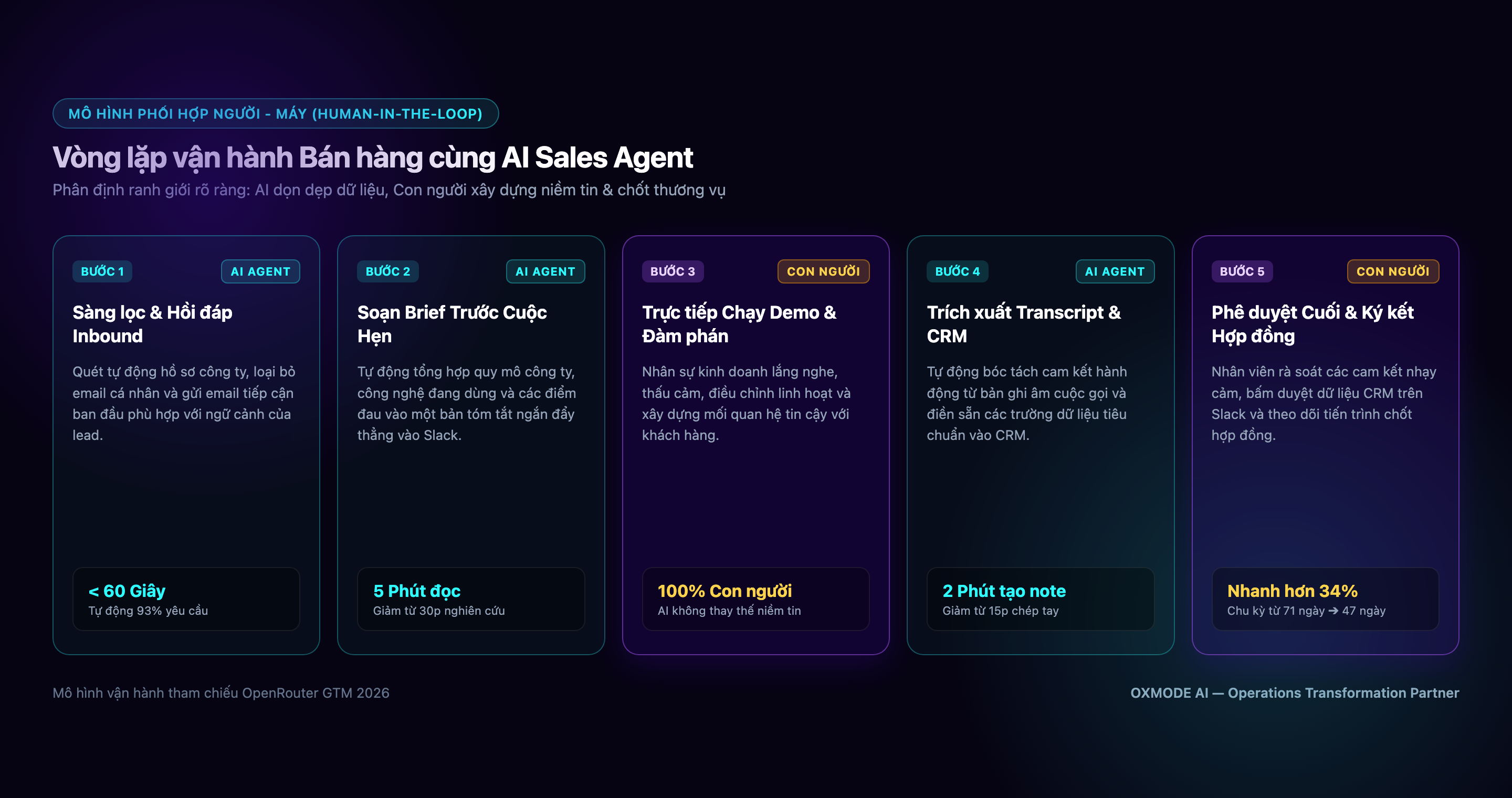
In fast-growing organizations, inbound triage frequently becomes an operational sinkhole. Prior to deploying Rasp, qualifying incoming submissions and writing personalized first-touch replies consumed 100% of one dedicated representative's capacity.
When volume exceeded capacity, the inevitable outcome was aggressive lead rationing: reps prioritized enterprise logos while smaller, viable accounts languished in the queue for days.
Rasp dismantled this bottleneck by autonomously handling 93% of initial outreach within 60 seconds of form submission. Prospects received contextual, accurate responses almost immediately.
However, the real operational discipline sits within the remaining 7%. OpenRouter resisted the temptation to force 100% autonomous throughput. Whenever an inquiry surfaced edge cases, sensitive procurement constraints, or ambiguous routing, Rasp proactively escalated the conversation to a human.
B2B buyers do not establish trust with automated agents. They build trust with people. Rasp provides the initial speed, but human representatives step in to cultivate the commercial relationship.
3. Discarding the Dashboard: The Slack Surface
Before arriving at Rasp, OpenRouter iterated through two earlier iterations named Ace and Dove. Both provided hard-won architectural lessons.
Meet Workers Where They Already Live
One of the most persistent errors in internal tooling is constructing standalone web portals and expecting operational staff to maintain an extra browser tab. In practice, initial excitement fades within weeks, and staff quietly revert to old habits.
OpenRouter's team works inside Slack. Consequently, Rasp operates entirely within Slack. Pre-call briefs arrive in Slack channels, email drafts surface in Slack threads, and human approval requests ping relevant reps directly. The agent embeds itself directly inside the team's natural communication flow.
A Unified Pipeline Over Custom Branches
Early prototypes gave every new task its own dedicated codebase. Over time, this architecture drifted into unmaintainable sprawl. With Rasp, the engineering team unified all tasks under a single execution pipeline, treating the task type as an input parameter. Crucially, every feature ships behind a feature flag that remains disabled by default until verified in production.
4. The Economics of Inference: Slashing Daily Costs
If an AI system costs more to operate than the human hours it recovers, the project represents an operational failure.
OpenRouter's early prototypes consumed nearly $800 daily across model calls and maintenance, primarily because they deployed premium frontier models indiscriminately across every task.
Rasp compressed that cost to roughly $30 daily, with API token inference accounting for roughly $18. They accomplished this through dynamic model routing:
| Model Tier | Prompt ($ / 1M tokens) | Completion ($ / 1M tokens) | Estimated Daily Cost (~200 turns) | Variance vs. GLM 5.2 |
|---|---|---|---|---|
| GLM 5.2 (Current Default) | $1.40 | $4.40 | ~$18.00 / day | Baseline |
| DeepSeek v4 Pro | $0.58 | $1.74 | ~$7.50 / day | 2.4x cheaper |
| GLM 5.3 Flash | $0.08 | $0.25 | ~$1.00 / day | 18x cheaper |
| DeepSeek v4 Flash | $0.04 | $0.10 | ~$0.50 / day | 37x cheaper |
Extracting meeting notes or checking whether an email belongs to a corporate domain does not require an expensive reasoning model. Diverting those repetitive steps to high-throughput flash models reduces per-task costs to pennies.
Reserving high-parameter frontier models strictly for complex strategic dossiers is the only approach that yields positive return on investment.
5. Where Should Growing Teams Begin?
The central hazard of case studies like OpenRouter is attempting to install an agent before the underlying business processes have been organized.
An AI agent cannot update a CRM if the pipeline stages and required fields have not been agreed upon. It cannot route incoming leads if the handoff between marketing, sales, and support remains ambiguous.
At OXMODE, our consulting engagements show that sustainable automation follows a disciplined sequence:
- Establish Data Foundations: Implement a structured, centralized data layer where custom fields and permissions are fully owned by the business (such as self-hosted NocoBase instances).
- Automate Core Data Plumbing: Connect web forms, internal messaging platforms, and databases using workflow automation engines like n8n, eliminating manual copy-pasting between disconnected tools.
- Deploy Targeted Intelligence: Once pipelines flow cleanly, introduce AI agents at specific, high-friction bottlenecks like meeting transcription, company background profiling, or first-touch triage.
Automation is not a magic fix for organizational disorder. It functions as an amplifier: applied to clean operational workflows, it doubles team velocity; applied to chaotic processes, it simply produces chaos at scale.