
In B2B commerce and competitive bidding, drafting Request for Proposal (RFP) responses remains one of the heaviest operational drains on internal teams.
A typical government or enterprise solicitation runs anywhere from 50 to hundreds of pages, dense with technical specifications, compliance mandates, and audit requirements. Faced with these massive documents, capture teams and program managers routinely spend weeks manually skimming text, extracting mandatory compliance statements, and copy-pasting historic credentials into rigid templates.
As solicitation volume scales, growing enterprises fall into a classic operational trap: either hire additional administrative headcount to keep up with formatting, or decline viable opportunities because internal capacity cannot meet strict deadlines.
In October 2026, Field Aerospace—an aircraft modification and defense contractor with approximately 250 personnel operating across North America—shared how they resolved this bottleneck by deploying an automated, self-hosted system built on n8n.
The operational metrics from their implementation demonstrate measurable efficiency gains:
- Drafting Velocity: Generating an 80% proposal starting draft dropped from two weeks of labor across 3 to 4 specialists down to approximately 25 minutes.
- Requirements Extraction: Parsing long solicitations to extract all mandatory compliance statements (shall, must, will) decreased from multiple hours to 15–20 minutes.
- Software Economics: The company eliminated two commercial third-party subscriptions, saving approximately $30,000 annually.
- Data Security & Auditability: The entire architecture runs 100% self-hosted on-premises, preventing sensitive defense contract details from leaking to external vendors.

1. The Operational Bottleneck: The Burden of 50-Page Solicitations
Prior to re-engineering their bidding workflow, Field Aerospace faced two persistent bottlenecks across business development operations.
The first was the sheer labor required to evaluate and respond to solicitations. When an RFP exceeded 50 pages, extracting mandatory compliance language required hours of manual line-by-line review. This administrative drag diverted senior engineers and program managers away from strategic value drivers like competitive pricing, supply chain risk assessment, and technical execution planning.
The second bottleneck was opportunity discovery lag. Thousands of government procurement notices are published and modified daily. Due to limited review capacity, capture teams occasionally identified relevant solicitations late in the bidding window. Teams were forced into high-stress, rushed submissions, increasing the risk of formatting errors and diminishing proposal win rates.
Meanwhile, the company paid thousands of dollars annually across disconnected third-party tools that failed to communicate with internal systems and raised compliance concerns regarding data sovereignty.
2. A 4-Tier Architecture: First Draft Acceleration
Rather than procuring another generic cloud service or expecting staff to write ad-hoc prompts into consumer chatbots, Field Aerospace architected an internal, self-hosted pipeline on n8n paired with a custom web interface.
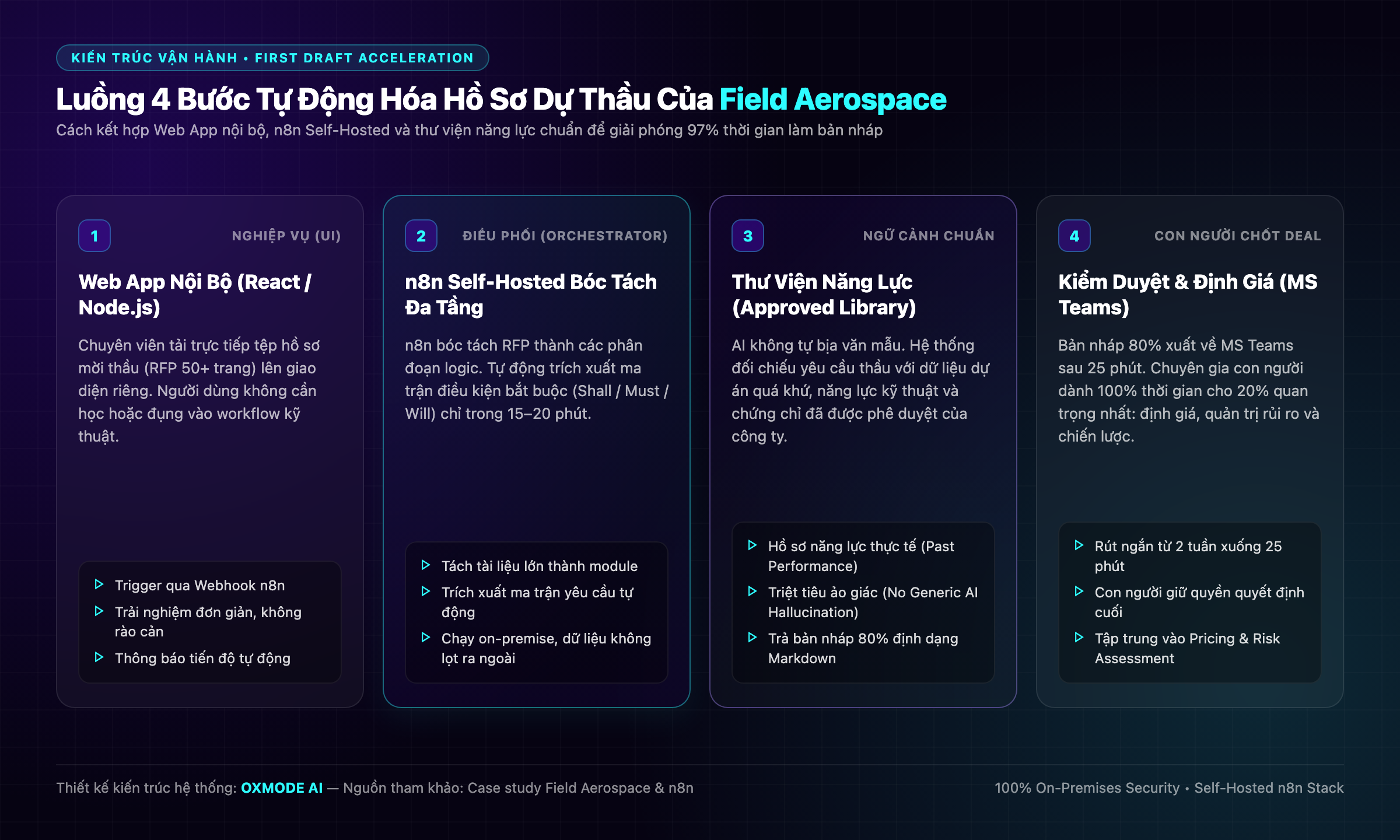
Their operational architecture is organized into four interconnected tiers:
PROPOSAL AUTOMATION ARCHITECTURE (FIELD AEROSPACE)

┌─────────────────────────────────────────────────────────────┐
│ 1. BUSINESS SURFACE (Internal Web App - React/Node.js)      │
│ Upload 50+ page RFP documents • Monitor jobs via Webhook   │
├─────────────────────────────────────────────────────────────┤
│ 2. ORCHESTRATION ENGINE (n8n Self-Hosted On-Premises)       │
│ Section chunking • Requirements extraction (15-20 minutes)  │
├─────────────────────────────────────────────────────────────┤
│ 3. CONTEXT GROUNDING (Approved Reference Library)           │
│ Map to historic past performance • Zero AI hallucination    │
├─────────────────────────────────────────────────────────────┤
│ 4. HUMAN DELIVERY & REVIEW (Microsoft Teams)                │
│ 80% Markdown draft in 25 mins • Human pricing & closer deal │
└─────────────────────────────────────────────────────────────┘
Step 1: Shielding Business Users with an Internal Web App
Business development leads and program managers should never be forced to navigate technical workflow graphs. Field Aerospace built an intuitive front-end portal using React and Node.js.
Users simply drag and drop solicitation documents into the portal. The web app triggers downstream n8n workflows via webhooks, monitors execution status, and alerts users upon completion without disrupting their natural work routines.
Step 2: Automated Requirements Extraction
Upon receiving a file, n8n orchestrates a workflow that chunks the document into logical sections. The engine systematically parses the text to identify all mandatory compliance triggers (such as shall, must, and will statements).
Within 15 to 20 minutes, the system produces a structured requirements matrix. Program teams receive an auditable checklist that eliminates the risk of missing critical contract specifications.
Step 3: Grounding Outputs with Approved Capability Data
This principle represents the cornerstone of sustainable enterprise automation: Never allow AI models to generate text without grounding in verified source data.
Field Aerospace connected the workflow to an internal library of approved past performance summaries, facility capabilities, and certification records. When generating section drafts, the system maps RFP requirements directly against verified historical performance. Drafts reflect authentic corporate capabilities rather than generic, hallucinated marketing filler.
Step 4: Delivering an 80% Solution to Microsoft Teams
Within roughly 25 minutes, the system compiles the structured response in Markdown and exports it directly into Microsoft Teams for review.
The draft is explicitly designated as an 80% starting baseline. Domain experts and program leadership bypass initial blank-page drafting and invest their expertise where human judgment matters most: refining pricing strategy, auditing technical risk, and finalizing the submission.
3. Automated Opportunity Scoring: Daily RFP Triage
Beyond response generation, Field Aerospace deployed n8n to automate upstream lead qualification.
They implemented a scheduled evaluator workflow that interfaces with the Deltek GovWin procurement database via API. Every morning, n8n retrieves solicitations published or amended over the prior 24 hours.
Instead of requiring analysts to manually review hundreds of listings, the workflow evaluates each opportunity against Field's corporate capability criteria. The system scores relevance and delivers a prioritized briefing to leadership. By surfacing high-probability bids early, teams gain valuable runway to assemble superior proposals.
4. Operational Takeaways for Growing B2B Enterprises
From our consulting engagements at OXMODE, Field Aerospace’s implementation offers three strategic takeaways for growing commercial teams:
- Position AI as a Draft Accelerator, Not a Closer: Automation fails when leadership expects software to run commercial negotiations autonomously. The highest return on investment comes from compressing the journey from 0% to 80%. Human specialists remain essential for pricing economics, client empathy, and contractual commitments.
- Prioritize Self-Hosted Data Sovereignty: B2B commercial proposals contain proprietary pricing models, bill-of-materials structures, and sensitive strategic data. Routing these assets through unverified public AI models introduces unacceptable operational risk. Self-hosted orchestration stacks (such as n8n paired with self-hosted NocoBase databases) ensure full data control while eliminating recurring SaaS overhead.
- Embed Workflows Inside Existing Work Surfaces: Do not force operational staff into secondary management portals. Build simple ingestion interfaces and deliver final outputs into existing communication channels like Slack, Lark, or Microsoft Teams.
When underlying data pipelines are structured cleanly, teams escape administrative paperwork and reinvest their hours into high-margin commercial growth.