The short answer
“AI Employee” should not be read as a promise that software can replace a person. In operations, it is a plain-language label for an AI assistant assigned a bounded role: preparing information, doing initial triage, drafting material, or suggesting a next step.
What matters is not the assistant’s name. It is the design of its assigned work, permitted data, permissions, owner, and points where people must approve.
What does an operational AI assistant need?
NIST’s AI RMF encourages organizations to incorporate trustworthiness considerations into the design, development, use, and evaluation of AI systems. For an SME, a practical way to apply that idea is to create a short role card for every assistant before connecting it to a workflow. NIST AI Risk Management Framework
The role card: six questions for every AI assistant
1. What is the work objective?
Describe one specific job, not a broad slogan. Hypothetical example: “prepare a summary of a new request for a coordinator to review,” rather than “handle customers.”
2. Which data may the assistant see?
List permitted data sources, sensitive data to exclude, and who can grant or remove access. Do not send data to AI simply because it exists in the system.
3. What may the assistant do—and not do?
Separate read, recommendation, draft creation, and execution permissions. An assistant may prepare an email draft without being allowed to send it; it may flag a record for review without being allowed to change its final status.
4. Who owns the rules and exceptions?
Assign an owner who understands the process. The owner reviews exceptions, updates instructions, checks changes, and decides when the assistant should pause.
5. Which points require human approval?
Set thresholds before deployment, especially where an action affects customers, payments, contracts, people, or published information. Human-in-the-loop is decision-right design, not merely a button at the end of a process.
6. What happens when the output is unsuitable?
Define how issues are recorded under company policy, who receives escalation, how the assistant is paused, and how the team returns to the manual step. Do not promise audit logging, security, or data retention behavior before the actual configuration and contract have been confirmed.
An illustrative workflow
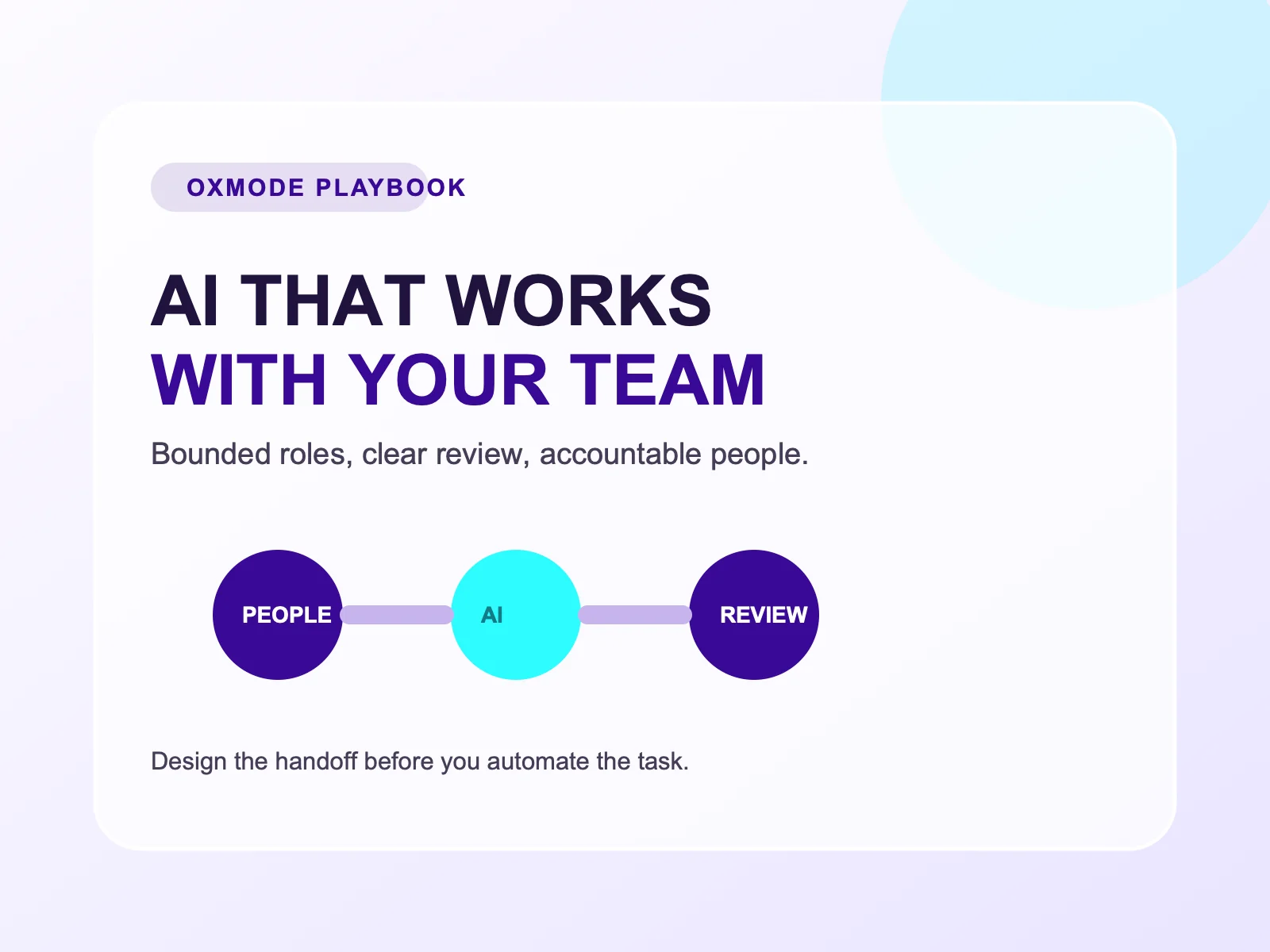
This is a hypothetical situation: a coordinator receives a new request. The AI assistant reads permitted content, prepares a summary, and suggests a handling group. The coordinator checks and corrects it if necessary, then decides whether to assign work. Workflow rules permit task creation only after the coordinator confirms.
This design separates AI assistance from human decision authority. It also makes clear where the organization needs to investigate when output is wrong or data changes.
Safety checks before using real data
- begin with test data or a narrow scope;
- review role-based access;
- confirm the expected configuration’s storage, data-transfer, and model-provider policies;
- identify content that must never be sent or changed automatically;
- sample and review outputs before expansion;
- document escalation and rollback paths.
NIST’s GenAI Profile is an additional reference for identifying and managing risks specific to generative AI. NIST AI 600-1: Generative AI Profile
Next step
Choose one narrow role for a first AI assistant, complete its role card with the process owner, and test it within an observable scope. If you speak with OXMODE, start with a review of workflow, data, and permissions to identify an appropriate scope.