Short answer
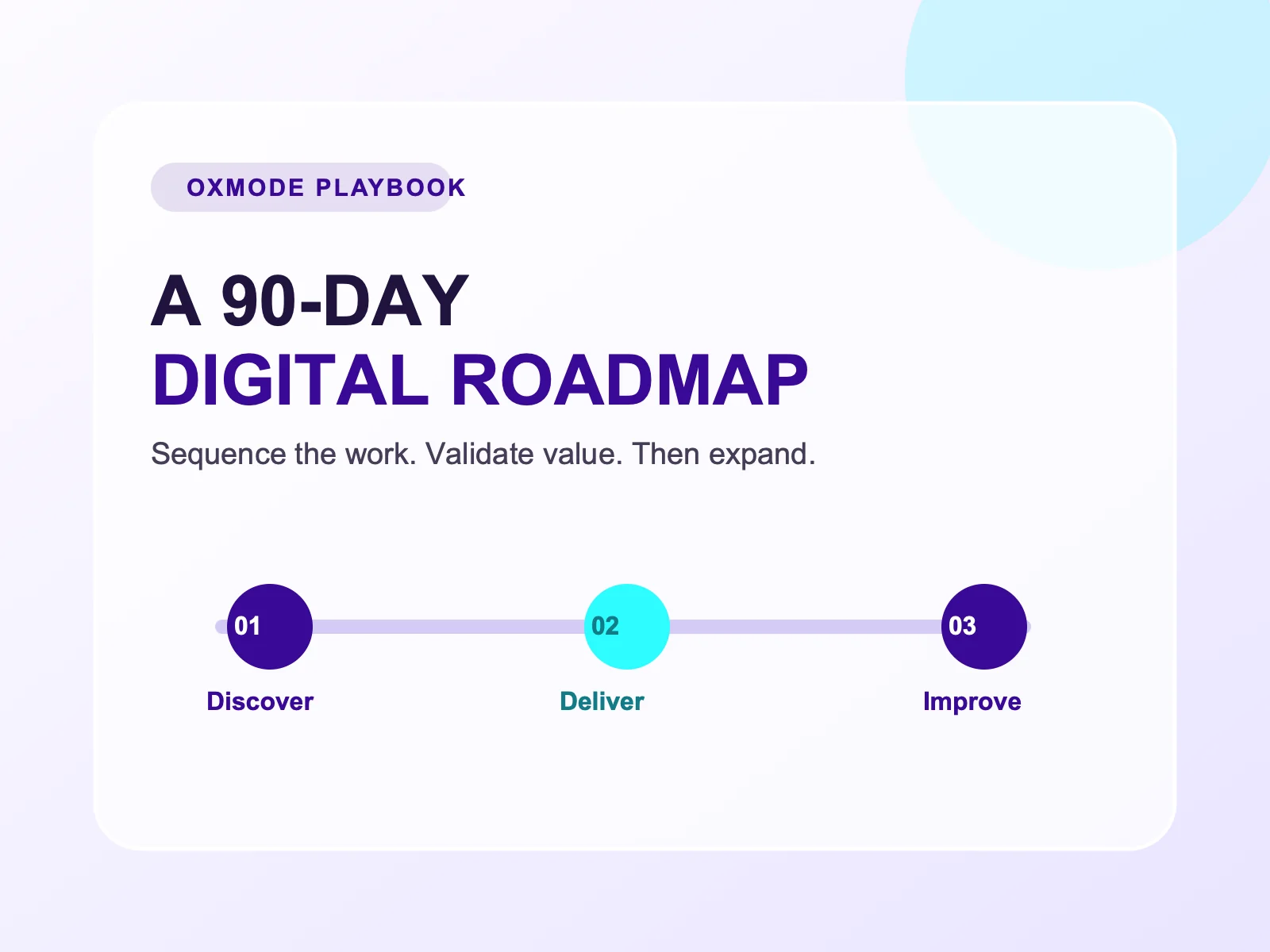
An opening phase should not be treated as a promise that an entire transformation will be complete by a fixed date. Its value is a better decision: which process deserves priority, what conditions must exist before delivery, who owns the change, and whether to expand or stop.
Reset the objective: solve a problem before buying a tool
Many teams begin with a software shopping list. That can turn the conversation toward features while the operating problem remains vague. Start with a specific situation instead: work that is delayed, repeatedly reworked, ownerless, or difficult to track.
A sensible first candidate has clear boundaries, real users, and does not require every department to change at once. The aim is not to select the most important process on paper. It is to select one the team can understand and test.
A decision map for the opening phase
Instead of following a rigid calendar, work through five checks:
- Problem: What friction exists, and what does it affect?
- Owner: Who can decide business rules and priority?
- Data: Which information is authoritative, who maintains it, and how are duplicates or gaps handled?
- Work change: At what step will people work differently?
- Next decision: What would justify expansion, adjustment, or stopping?
If one of these is unclear, technology should not conceal it. It is work to resolve first.
Select one process to start with
Use a simple scoring discussion rather than instinct. For each candidate process, ask whether the issue can be described through operating examples, whether inputs and outputs can be identified, whether an owner exists, whether the consequence of error is controllable, and whether users are willing to try a changed routine.
Prioritize a process when the answers can be tested in practice. Avoid beginning with decisions that directly affect payments, contracts, or complex exceptions when the team has not defined approval and recovery paths.
Design an experiment, not a promise
A useful experiment states its boundaries: which users take part, which records are used, which rules apply, which cases remain manual, and who may pause the work.
Document assumptions at the outset. Data may be incomplete, the process may change once used, or an integration may require separate assessment. Clear assumptions let the team learn from results instead of arguing from impressions.
Put adoption inside the delivery scope
A system is only one part of change. Users need to know when to use it, which old practice is ending, where to get help, and how feedback becomes a rule change.
Nominate an operations representative to collect feedback and an owner to decide on rule changes. Training should use real work situations, not only a feature walkthrough.
The review: continue, adjust, or stop
At the end of the opening phase, the goal is not to prove everything is perfect. The team should be able to answer: is the new process being used as agreed; is the data reliable enough for its current purpose; which exceptions appeared; which risks need more controls; and is the next step worth the effort?
Three outcomes are valid: expand to the next scope, adjust and test again, or stop because the problem is not ready. Stopping a controlled experiment can prevent an unsuitable design from being scaled.
When scope support is useful
For a conversation about process, data, and decision criteria before selecting a solution, see digital transformation strategy consulting. Once the scope is clearer, no-code implementation provides related service context. Neither page replaces an assessment of scope, terms, and fit for a specific organisation.
Checklist for the first working session
- Describe one process through its start event, steps, output, and exceptions.
- Name an owner with decision authority.
- List data sources and known data-quality issues.
- State what is outside the experiment.
- Agree how feedback, incidents, and the next decision will be recorded.
This framework can occupy different amounts of time depending on scope, data, integrations, approvals, and team readiness. It is not a commitment to a delivery schedule or outcome.