
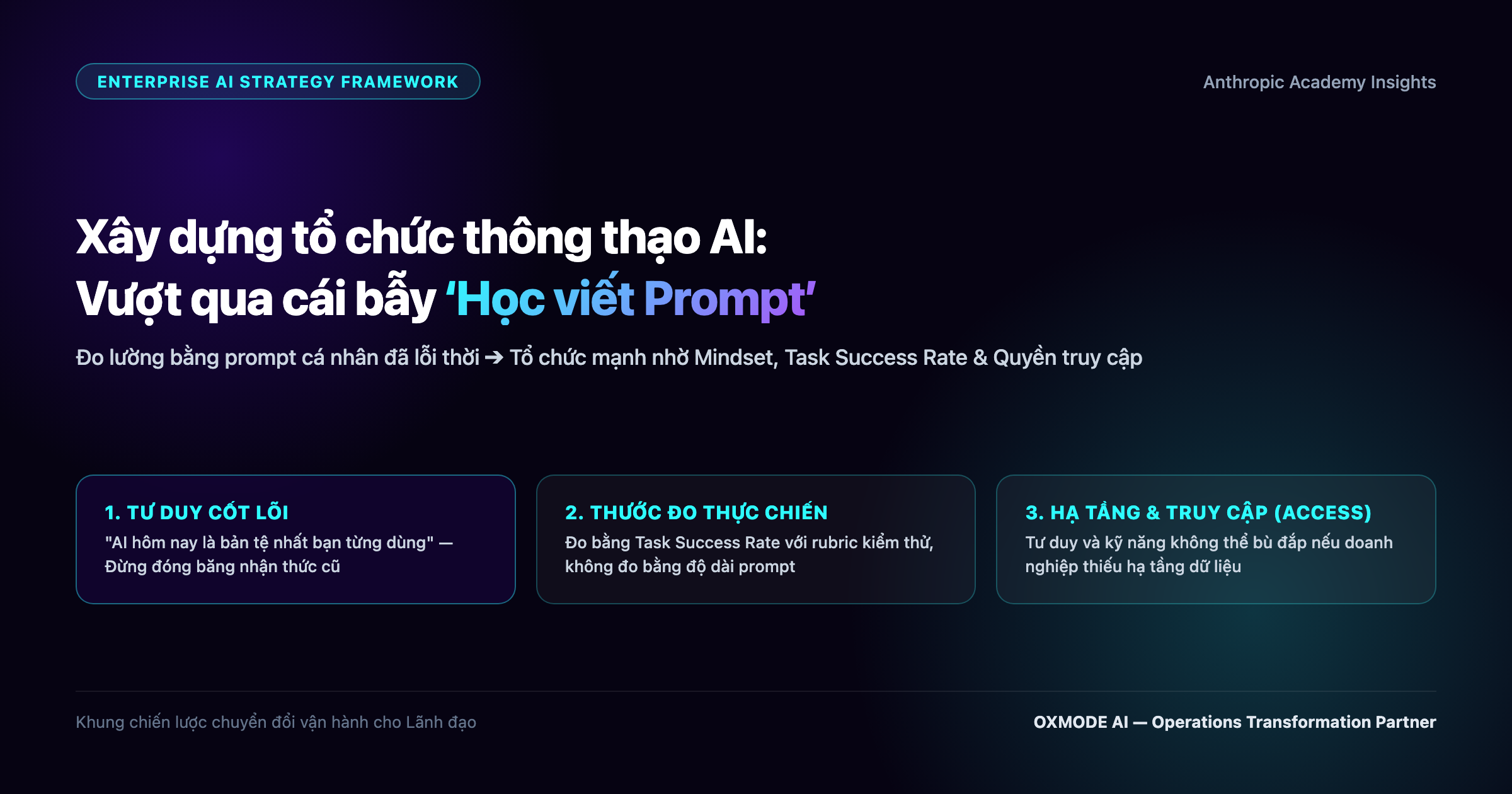
When business leaders seek to introduce artificial intelligence into daily operations, they frequently default to an intuitive playbook: hosting internal workshops teaching staff how to "prompt".
Employees learn persona assignments, elaborate context framing, and stylistic instructions. Yet within weeks, the initial novelty evaporates. Staff revert to familiar routines, relegating AI to sporadic email proofreading, basic document summarization, or abandoning it entirely after early outputs fail to match expectations.
In October 2026, Anthropic Academy published a foundational operational guide titled Building AI-fluent organizations.
Their overarching conclusion is unambiguous: Measuring organizational AI capability through individual prompting behaviors is fundamentally obsolete.
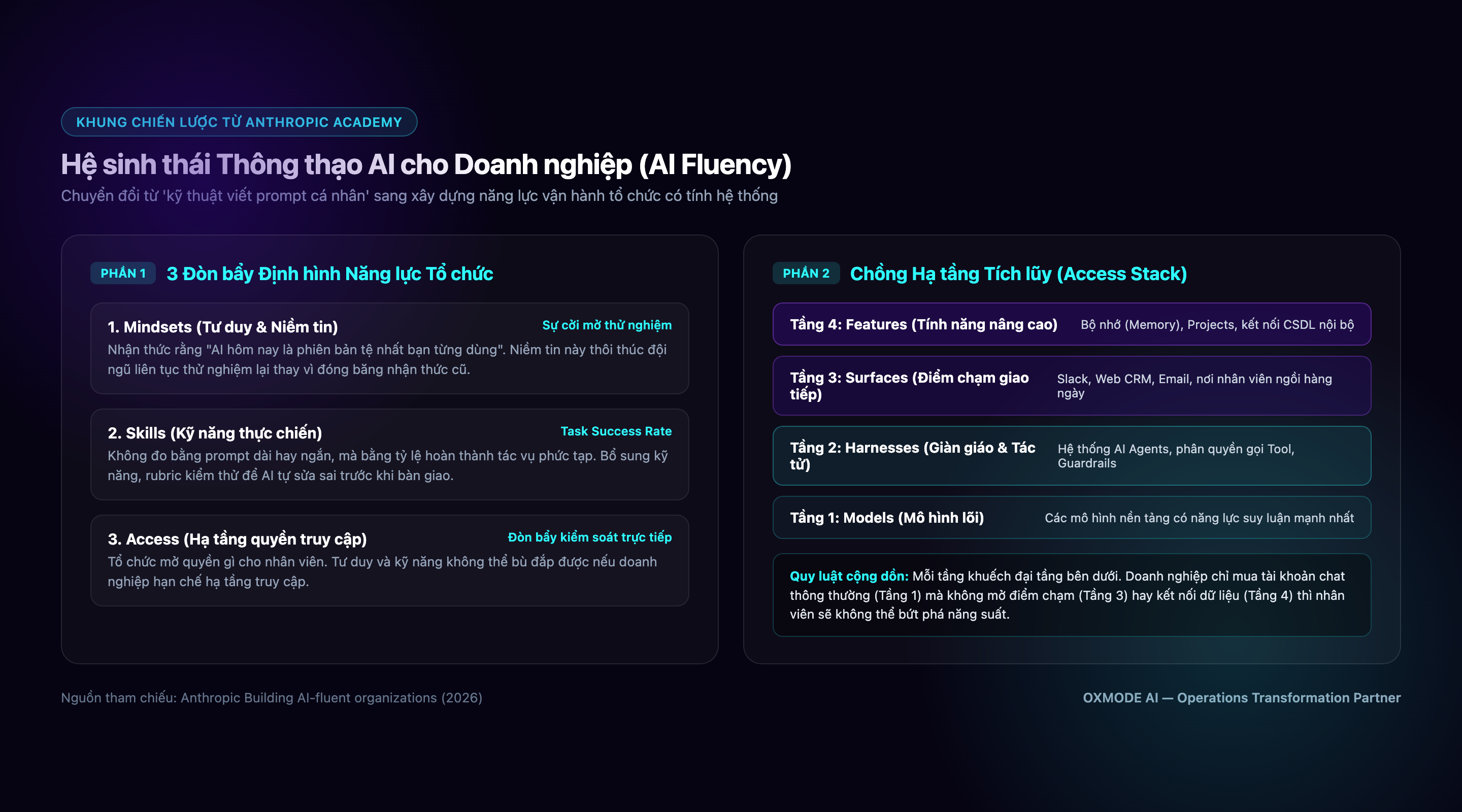
As foundation model intelligence compounds, frontier systems increasingly infer intent, context, and structural formatting autonomously. To cultivate genuine organizational fluency, leadership must treat AI adoption not as an ad-hoc personal skill, but as an interconnected ecosystem anchored by three operational levers: Mindsets, Skills, and Access.
1. The Mindset Lever: Today’s AI Is the Worst You Will Ever Use
In most commercial organizations, employee attitudes toward AI harden after their first few failed trials. When a team asks a chatbot to parse a messy operational spreadsheet and receives a flawed hallucination, the default reaction is to conclude: "AI cannot handle this job"—freezing that mental model for months.
Anthropic highlights a core psychological shift leaders must actively instill across teams: The AI model you interact with today is the least capable version you will ever encounter.
Every operational cycle, reasoning capabilities and context windows expand substantially. Bottlenecks that broke frontier systems six months ago are executed seamlessly by lightweight flash models today.
Unless organizations institutionalize the habit of continuously re-testing outdated operational assumptions, digital transformation stalls. Building a mature AI culture is not about fostering blind faith; it is about cultivating deliberate, continuous experimentation against emerging model capabilities.
2. Practical Skills: Shift from Prompt Syntax to Task Success Rate
Within commercial environments, technical fluency cannot be evaluated by prompt length or rhetorical flair. The sole metric that matters is Task Success Rate—the frequency with which a multi-step business workflow completes correctly.
Anthropic illustrates this through empirical trials measuring a demanding task over 50 consecutive runs:
- Generic prompt instructions produce erratic, inconsistent results.
- Introducing specialized procedural skills standardizes output formats and dramatically stabilizes performance.
- Integrating explicit evaluation rubrics—allowing the AI to audit its own output through adversarial validation before human delivery—elevates task reliability to mission-critical standards.
An AI-fluent professional understands how to structure enterprise context, decompose ambiguous operational problems into deterministic steps, and architect self-correcting feedback loops.
3. The Access Lever: The Compounding Technology Stack
Access represents the single lever management controls most directly, yet it remains the most common point of failure.
Founders frequently complain that employees resist adoption, yet an audit reveals the company merely provisioned entry-level, disconnected chat subscriptions.
Anthropic models access as a compounding four-tier technology stack, where higher layers exponentially multiply the utility of foundation layers:
THE COMPOUNDING ACCESS STACK

┌─────────────────────────────────────────────────────────────┐
│ LAYER 4: FEATURES                                           │
│ Long-term Memory, Project Workspaces, Internal Database APIs│
├─────────────────────────────────────────────────────────────┤
│ LAYER 3: SURFACES                                           │
│ Slack, Web CRM, Email — Where Staff Actually Conduct Work   │
├─────────────────────────────────────────────────────────────┤
│ LAYER 2: HARNESSES                                          │
│ Agentic Scaffolding, Tool Calling, Permissions & Guardrails │
├─────────────────────────────────────────────────────────────┤
│ LAYER 1: MODELS                                             │
│ Frontier Foundation Reasoning Engines (Claude, GPT, DeepSeek)│
└─────────────────────────────────────────────────────────────┘
- Models: Are teams restricted to legacy consumer tiers, or equipped with frontier reasoning architectures?
- Harnesses: Are models wrapped in agentic execution harnesses with tool-calling permissions to query databases and execute verified logic?
- Surfaces: Where does AI live? Forcing employees to open a separate external browser tab guarantees abandonment. AI must embed directly within Slack, email, or core enterprise dashboards.
- Features: Can the system retain organizational memory and query proprietary data, or must users rebuild context from scratch every morning?
Anthropic underscores a pivotal operational law: Mindset and personal skill cannot compensate for deficient enterprise access. Without native tooling integrations and secure data plumbing, employee ingenuity remains trapped within basic text editing.
4. Operational Takeaways for Growing Enterprises
From our consulting work at OXMODE, Anthropic’s framework explains precisely why dozens of SME digital initiatives lose momentum after early pilot stages.
Transitioning from isolated experimentation to enduring institutional capability requires leadership to address three diagnostic questions:
- On Mindsets: Are internal teams discarding valuable automation opportunities based on limitations observed six months ago?
- On Skills: What is the most complex operational task your teams can reliably complete end-to-end alongside an agent today?
- On Access: Have you embedded AI directly into daily communications (Slack) and connected it to your proprietary data records?
When organizations unify a structured data foundation (Data Layer via NocoBase), resilient event plumbing (Automation Layer via n8n), and domain-specific agents (Intelligence Layer), individual employee leverage multiplies dramatically.
That represents the true threshold of enterprise AI fluency.


